Follow the Money: Who's Really Been Drawing Your Map for 200 Years
The Business of Getting Lost
In 1869, when Grenville Dodge was surveying the route for the transcontinental railroad, he wasn't just laying track—he was drawing the first draft of how Americans would move through their continent for the next century and a half. Every mile of rail represented a business decision about which towns would thrive and which would die, which landscapes would become destinations and which would remain empty space between somewhere and somewhere else.
This wasn't an accident. It was the beginning of an American tradition that continues every time you tap "start navigation" on your phone: someone else, with their own financial agenda, telling you exactly where to go.
Human psychology hasn't changed in five thousand years, and neither has our willingness to let others navigate for us the moment the technology exists. What has changed is how sophisticated the business model behind that navigation has become.
The Guidebook Conspiracy
The first American travel guides weren't written by wandering poets or curious explorers—they were marketing materials produced by transportation companies. When "Appleton's Railway and Steam Navigation Guide" hit bookstores in 1847, it looked like helpful travel advice. In reality, it was an elaborate advertisement for specific rail lines, steamboat companies, and hotels that had paid for inclusion.
The psychology was brilliant: instead of selling you a ticket, they sold you a dream of the journey. The guidebook made you complicit in your own targeting. You thought you were choosing your route, but you were actually following a path designed to maximize someone else's profit.
This pattern repeated across every new navigation technology. When the American Automobile Association began publishing road maps in 1905, they weren't performing a public service—they were selling tires. AAA was founded by tire manufacturers who understood that better roads and clearer directions meant more driving, which meant more tire sales. Every mile marker they recommended was a mile closer to their bottom line.
 Photo: American Automobile Association, via www.shutterstock.com
The Federal Route Salesmen
Even government-sponsored navigation came with a business agenda. When the Federal Highway Administration began standardizing road signs in the 1930s, they weren't just making travel safer—they were creating a national advertising network. The green signs directing you to "Food," "Gas," and "Lodging" at every exit weren't neutral information; they were taxpayer-funded billboards for businesses that had lobbied for highway access.
The Interstate Highway System, sold to Congress as a defense project, was actually the largest government-subsidized business development program in American history. Every mile of highway was designed to move traffic past specific commercial districts, through particular cities, and around competing routes that might benefit different economic interests.
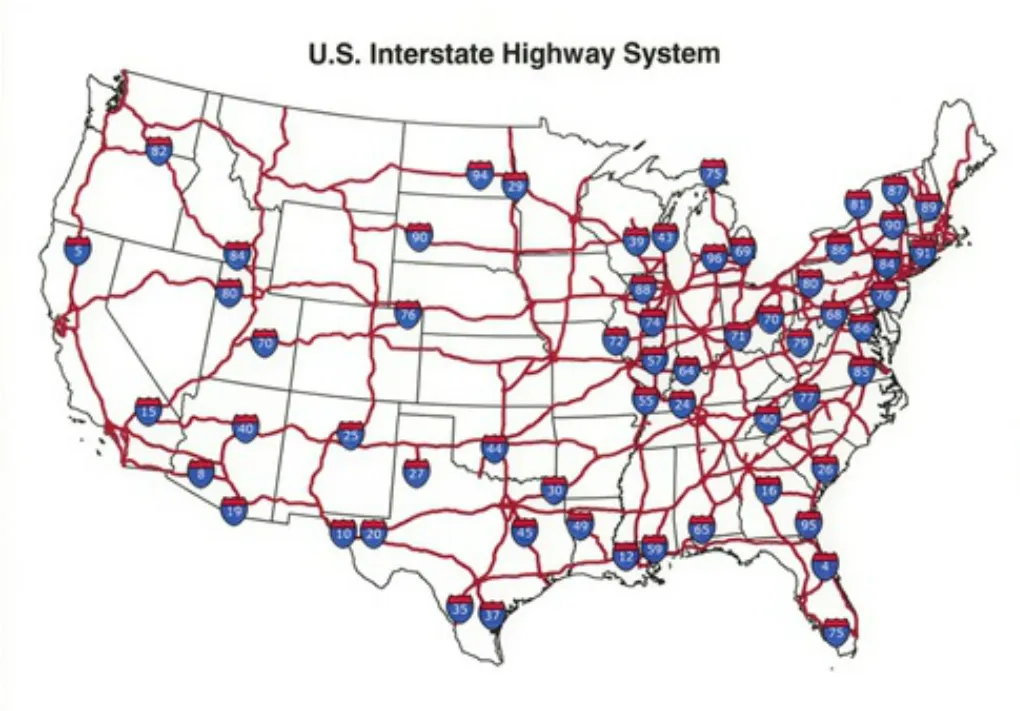 Photo: Interstate Highway System, via highwayactof1956.weebly.com
Look at any interstate exit today and you'll see the result: identical clusters of gas stations, fast food restaurants, and chain motels that exist solely because federal engineers decided to put an off-ramp there in 1962. The businesses didn't follow the roads—the roads were designed to create the businesses.
The Algorithm Knows Where You Should Eat
Modern GPS navigation represents the culmination of two centuries of commercial route guidance, but with a twist that would make the railroad barons jealous: the system knows not just where you're going, but where you've been, what you buy, and how much you're willing to spend to get there faster.
When Google Maps suggests a route that takes you past a Starbucks, that's not a coincidence. When Waze offers to save you five minutes but routes you through a commercial district instead of residential streets, that's not just about traffic optimization. The algorithm has learned to monetize your impatience, turning your desire to save time into revenue for businesses that pay for preferential routing.
The psychology is the same as it was in 1847: you think you're getting neutral directions, but you're actually following a commercial agenda that's become so sophisticated it can predict your needs before you know you have them. The difference is that now the system learns from your behavior, adjusting its recommendations based on millions of data points about who you are and what you're likely to buy.
The Illusion of Choice
Every major advance in American navigation technology has been sold as liberation—the freedom to go anywhere you want. But the reality has always been more complex: you can go anywhere you want, as long as you follow the routes someone else has chosen for you.
This isn't necessarily malicious. The businesses that have shaped American navigation have generally provided real value: better roads, clearer directions, faster routes. But they've also ensured that your idea of "anywhere" is limited to places that generate revenue for someone.
Consider the modern American road trip, that supposed symbol of freedom and spontaneity. Every "discovery" you make—the quirky diner, the scenic overlook, the charming small town—has probably been featured in a guidebook, marked on a map, or recommended by an algorithm. Your spontaneous adventure is following a script written by people who profit from your sense of discovery.
The Roads Not Taken
The most revealing thing about American navigation isn't the routes we've been encouraged to take—it's the ones we've been steered away from. The scenic highways that don't connect commercial centers. The small towns that never got interstate access. The neighborhoods that GPS systems seem to avoid for reasons that are never quite explained.
Every navigation system embeds the biases and business interests of its creators. When early automobile maps avoided marking certain neighborhoods, they weren't just reflecting social prejudices—they were reinforcing them, making some parts of America invisible to travelers who relied on official directions.
This continues today in digital form. The areas where GPS signals are mysteriously unreliable, where recommended routes seem to avoid certain streets, where "traffic optimization" consistently directs drivers away from specific communities—these aren't technical glitches. They're the digital version of the same commercial and social filtering that's shaped American navigation for two centuries.
Navigating the Navigators
The history of American navigation reveals a fundamental truth about human psychology: we'll outsource our sense of direction to anyone who offers to make the journey easier. But every time we do, we give up a little bit of control over where we end up.
This doesn't mean you should throw away your GPS and navigate by the stars. It means understanding that every route recommendation comes with an agenda, and that agenda isn't necessarily aligned with your interests. The most honest navigation might be the kind that admits its biases upfront, rather than pretending to offer neutral directions to nowhere in particular.
The next time your phone suggests a route that seems unnecessarily complex, or your GPS insists on taking you through a particular commercial district, remember: you're not just getting directions. You're participating in a 200-year-old American tradition of profitable guidance, where the people telling you where to go have always had somewhere they wanted you to end up.