Going Once, Going Twice, Gone: The American Towns That Voted to Erase Themselves
Going Once, Going Twice, Gone: The American Towns That Voted to Erase Themselves
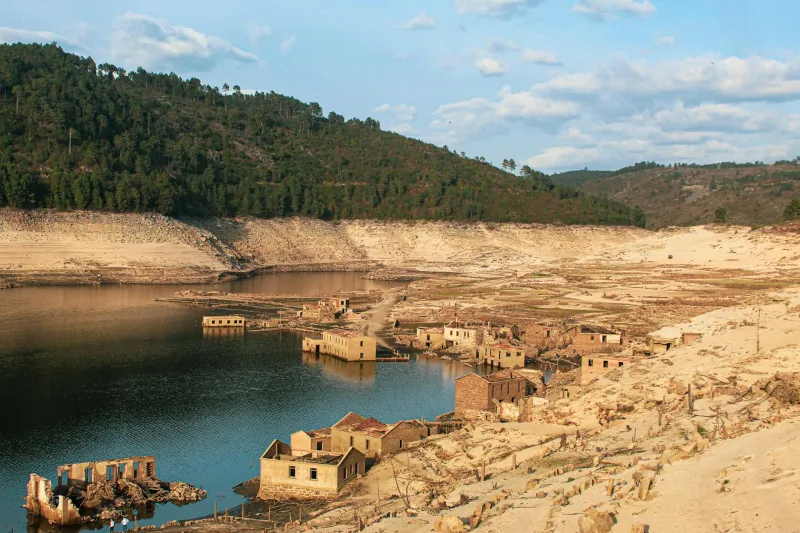
There's a peculiar kind of road trip you can take in central Massachusetts. You drive out to the Quabbin Reservoir — one of the largest inland bodies of water in the eastern United States, genuinely beautiful, genuinely worth the drive — and you stand at the edge of it knowing that somewhere under the water, there are cellar holes. Old roads. A cemetery or two. The bones of four towns that voted to let themselves be flooded so that Boston could have clean drinking water.
The towns were Dana, Enfield, Greenwich, and Prescott. They didn't disappear because of a disaster. They disappeared because enough of their residents, after years of argument, eventually said yes.
That's the part worth sitting with.
What It Actually Takes to Get a Community to Agree on Its Own Ending
Human beings are famously bad at accepting loss. Behavioral economists have a term for it — loss aversion — and decades of research confirms that people weight losses roughly twice as heavily as equivalent gains. You don't need a lab study to know this. You've watched it play out at every city council meeting, every school consolidation vote, every time someone proposes closing the local post office.
But here's what's interesting: towns have voted themselves out of existence. Not once, not twice — dozens of times across American history, from 19th-century Ohio river towns that merged with larger neighbors to Depression-era communities that dissolved rather than maintain services they could no longer afford. And when you look at how those votes actually happened, the same pattern shows up over and over again.
First comes denial. Then a long middle period of argument that looks like confusion but is actually negotiation. Then, eventually, a specific kind of exhaustion that tips the vote.
The past has run this experiment many times. The results are pretty consistent.
The Quabbin Towns: A Case Study in Collective Grief
The Swift River Valley communities didn't go quietly, and they didn't go quickly. The Metropolitan District Water Supply Commission started eyeing the valley in the 1920s. The actual flooding didn't finish until 1946. In between, residents spent roughly two decades in a kind of suspended civic grief — knowing the end was coming, arguing about compensation, watching their institutions close one by one.
Enfield held a formal farewell ball on April 27, 1938. People drove in from across New England to attend. There was dancing. There were speeches. The selectmen of a town that was about to stop existing gave toasts.
That detail matters more than it might seem. Researchers who study community dissolution — and yes, that's a field — have found that formal rituals of closure are one of the few things that actually help populations move through collective loss rather than around it. The Enfield ball wasn't sentimentality. It was, functionally, the mechanism by which a community gave itself permission to end.
Today you can visit the Quabbin Reservation and walk the old roads. The MDC (now part of the DCR) maintains some of the landscape. On very low-water years, the tops of old stone walls break the surface. The visitor center in Belchertown has photographs. It's one of the more quietly haunting day trips available in New England, and it costs nothing but gas.
Ohio's River Towns and the Economics of Letting Go
The Quabbin story is dramatic because the method was dramatic. But most American town dissolutions were quieter and more mercenary.
Throughout the 19th century, as railroads reshaped which towns mattered and which ones didn't, dozens of Ohio and Indiana river communities faced a version of the same math: the economic reason for their existence had moved, and maintaining local government cost more than the remaining residents could reasonably pay. The towns that successfully dissolved — that actually completed the legal process and merged with neighbors or simply ceased to exist as incorporated entities — tended to share a few characteristics.
They had a clear external pressure (economic decline, infrastructure cost, a water project) that made the status quo obviously unsustainable. They had at least one vocal faction that framed dissolution as choosing an outcome rather than suffering one. And they had, critically, some kind of concrete offer on the table — a merger agreement, a compensation package, a reservoir contract — that gave the loss a legible shape.
The towns that didn't dissolve, that dragged on for decades as near-ghost communities with nominal governments and no services, typically lacked that last piece. When the loss has no defined shape, loss aversion wins. People will hold onto a thing they can't describe losing more fiercely than a thing they can.
The Argument Happening Right Now
Drive through rural America today and you'll find communities having versions of this exact conversation. Small towns in Kansas, Mississippi, upstate New York, the hollows of Appalachia — places where the population has dropped below the threshold that makes local government financially rational, where the school closed and the hospital is forty-five minutes away and the main street has more empty storefronts than occupied ones.
The arguments in those towns sound, in their structure, almost identical to the arguments in the Swift River Valley in 1930. There's a faction that frames staying as identity and leaving as surrender. There's a faction that frames consolidation as pragmatism and continued independence as denial. There's usually a third faction that just wants someone to tell them what's actually going to happen so they can plan their lives.
This isn't a failure of those communities to think clearly. It's a documented feature of how humans process collective loss. The five-thousand-year record on this is pretty unambiguous: we argue in the same sequence, we stall in the same ways, and we move when we have a concrete alternative to move toward.
Going to See What's Left
If you want to understand this dynamic physically — and there's something about standing in a place that makes the history legible in a way that reading about it doesn't — the Quabbin is the obvious destination. The DCR runs guided tours in season. The old Enfield town common is still faintly visible. You can rent a canoe.
But you can also just drive the back roads of any region that went through a consolidation wave. Look for towns with a historical marker and no current post office. Look for county seats that seem too small for the job. Look for the places where two or three old town names show up in the same ZIP code, which usually means someone, at some point, made the vote happen.
The towns that chose to disappear left something behind, even when they left it underwater. They left a record of what it actually takes to get people to agree on an ending — and that record, it turns out, is one of the more useful things history has to offer.