The View Was Always for Sale: The Calculated Commerce Behind America's Most Mythologized Roads
The View Was Always for Sale: The Calculated Commerce Behind America's Most Mythologized Roads
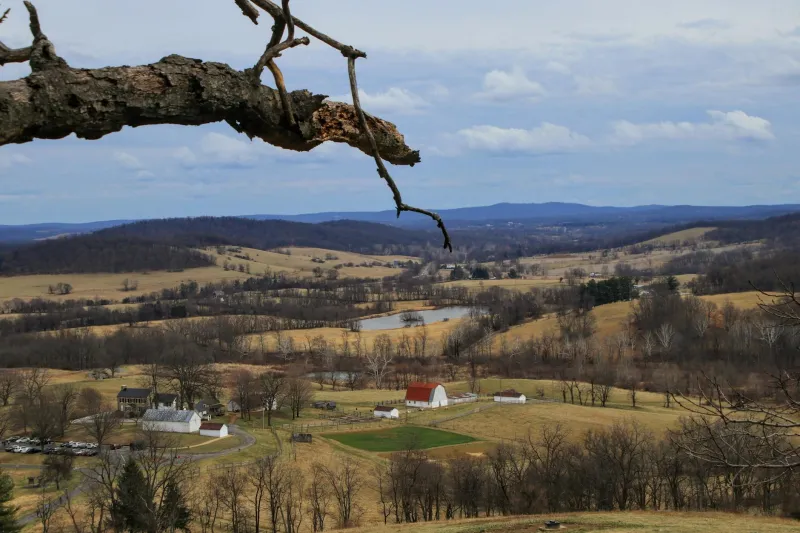
There's a pullout on the Blue Ridge Parkway in Virginia, somewhere around milepost 20, where you can stop the car and look out over a valley that appears to have been arranged by someone with a very good eye for composition. Layered ridgelines, morning fog in the hollows, the particular blue-gray haze that gives the mountains their name. It feels accidental. Discovered. Like you found it.
You didn't find it. It was built for you. The viewshed you're looking at was cleared and maintained by the National Park Service according to design specifications developed in the 1930s by landscape architects who were thinking very carefully about what a motorist should see, at what moment, from what angle, in order to generate the specific emotional response that would make them want to come back and bring their friends.
This is not a criticism. It's just accurate. And understanding it changes the drive from a passive experience into something considerably more interesting.
The Parkway as a Political Object
The Blue Ridge Parkway was not built because someone looked at the Appalachian ridgeline and thought it deserved a road. It was built because two states — Virginia and North Carolina — were competing viciously for the economic development that the proposed southern extension of Skyline Drive represented, and a Roosevelt administration official named Harold Ickes made a routing decision in 1934 that was as much about political geography as scenic merit.
The Parkway runs 469 miles through some of the most economically distressed territory in the eastern United States. That was the point. The New Deal logic was explicit: build a road that brings wealthy motorists from northern cities through Appalachian communities that need the money. The scenery was the product. The communities along the corridor were the intended beneficiaries.
The landscape architects who designed the Parkway — most notably Stanley Abbott, who served as the project's resident landscape architect for decades — worked from an aesthetic philosophy that treated the entire visible landscape as a designed object. Farms that fell within the viewshed were managed to look appropriately pastoral. Structures that interrupted the rural character were removed or screened. The "natural" landscape you see from the Parkway is, in significant stretches, a maintained fiction — a designed version of what the mountains should look like to a motorist in a 1930s automobile.
This is, when you think about it, a remarkable act of architectural ambition. The building is 469 miles long and the walls are mountains.
Route 66 and the Invention of the Authentic
Route 66 has a more complicated relationship with its own mythology, partly because the mythology was invented so consciously and so early.
The road was commissioned in 1926 and the promotional apparatus started almost immediately. Cyrus Avery — the Oklahoma highway official who is credited as the primary force behind the route's designation — was also one of the primary forces behind its marketing. The U.S. Highway 66 Association, founded in 1927, was a chamber-of-commerce operation from the beginning: its explicit purpose was to promote travel along the corridor to benefit the businesses along the corridor.
The "Main Street of America" slogan wasn't organic. It was a campaign. The idea of Route 66 as a democratic road, a road for ordinary Americans moving west with their dreams and their car trouble, was a story the road's boosters told before Steinbeck crystallized it in fiction and before the TV show made it a national archetype.
None of that makes the Steinbeck less true, exactly. The Okies really did move west on that road. The diners and motor courts and trading posts really did exist. But they existed in a commercial ecosystem that had been deliberately cultivated, and the mythology that grew up around the road served the commercial ecosystem's interests as much as it served any larger American truth.
You can drive the surviving stretches of Route 66 today — through the Texas Panhandle, through eastern New Mexico, through the Painted Desert — and the experience is genuinely moving. The ruins of the motor courts and the surviving diners and the wide flat horizon are all real. But you're also driving through a very effective piece of marketing that has outlasted most of the businesses it was designed to support. That's a strange and interesting thing to be doing.
The Pacific Coast Highway and the Infrastructure of Desire
California Highway 1 along the Big Sur coast is possibly the most photographed road in the United States. It is also, structurally, a public works project that was justified to the California legislature partly on the grounds that it would open up coastal timber and agricultural resources and partly on the grounds that it would generate tourism revenue for communities that had no other practical access to markets.
The scenic mythology came later. Or rather, it was cultivated simultaneously with the economic justification, because the people building the road understood that the scenery was the economic argument. If you could make people want to see the California coast badly enough, the road would pay for itself in tourist dollars.
The construction of Highway 1 through Big Sur required blasting through cliff faces and bridging river gorges. The Bixby Creek Bridge — the arched concrete span that appears in roughly one-third of all Big Sur photography — was built in 1932, and its elegant design was not incidental. California's Division of Highways had learned, by the early 1930s, that the aesthetics of infrastructure affected the tourist value of the corridor it served. A beautiful bridge generated more return visitors than a utilitarian one.
This is, again, a remarkable thing to know while you're standing on the Bixby Bridge overlook watching seventeen other people take the same photograph. The bridge was designed partly to be photographed. The photograph was always the product.
Does Knowing This Ruin Anything?
The short answer is no, and the longer answer is that it makes these roads significantly more interesting as objects of study.
Human beings have been designing environments to produce specific emotional responses for as long as they've been building anything. The Egyptian temple complexes were designed to make visitors feel small and awed. Medieval cathedrals were designed to make visitors feel transcendence through light and scale. The Blue Ridge Parkway was designed to make 1930s motorists feel like they'd discovered a pristine American wilderness that had been waiting just for them.
All of those designed experiences are also real experiences. The awe in the temple is real. The transcendence in the cathedral is real. The feeling of discovery on the parkway pullout is real. The fact that someone engineered the conditions for that feeling doesn't make the feeling a fraud.
What it does do is add a layer to the experience. When you drive the Blue Ridge Parkway and understand that the landscape was curated, you're not just a tourist consuming a view — you're passing through a designed object that tells you something about what Americans in the 1930s thought their country should look like, and what they thought would make other Americans want to visit it, and what economic anxieties they were trying to solve with a road.
That's a richer trip than just the scenery. The scenery is still there. It's still worth the pullout. But now you know what you're actually looking at.
A Note on Where to Go
If you want to experience this dynamic in concentrated form, the Blue Ridge Parkway Visitor Center near Asheville has exhibit material on the Parkway's design history that's more candid than you might expect from a federal facility. The Route 66 Museum in Clinton, Oklahoma does a good job of documenting the promotional history alongside the cultural history. And if you stop at the Bixby Bridge on Highway 1 and look at the bridge itself instead of just through it, you'll see the care that went into making an infrastructure object beautiful enough to anchor a mythology.
The view was always for sale. It's still a very good view.