Paper Territories: How Every Map You've Ever Trusted Was Someone's Sales Pitch
The Business of Believing What You See
Every tourist who's ever squinted at a hotel brochure map wondering why the beach looks so much closer than it actually is has stumbled into humanity's oldest confidence game. For thousands of years, people with ink and ambition have discovered the same psychological truth: show someone a map, and they'll believe the world looks exactly like you drew it.
This isn't about innocent mistakes or primitive surveying tools. This is about the deliberate art of cartographic persuasion — the practice of drawing the world not as it is, but as someone needs you to think it is. And if you think GPS has made us immune to these tricks, you've clearly never tried to find a Starbucks using a mall directory.
Monsters, Margins, and Marketing
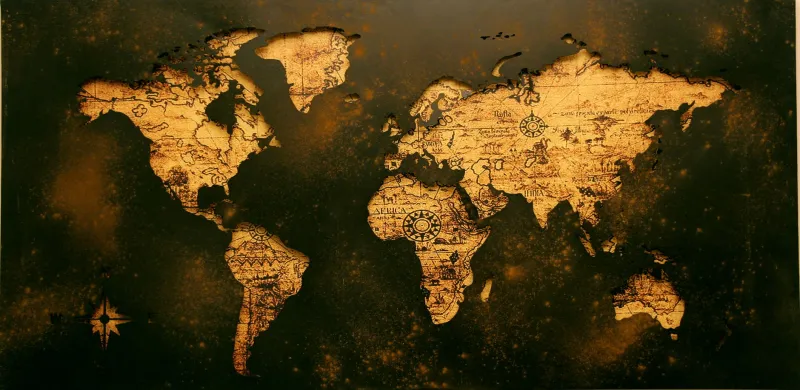
Medieval mapmakers faced a fundamental business problem: paying customers wanted complete maps, but nobody had actually been everywhere. The solution was brilliant in its simplicity — fill the unknown spaces with whatever would sell the most maps.
Sea monsters weren't decorative flourishes; they were strategic marketing. A dragon in the North Atlantic told European merchants exactly what they wanted to hear: those waters were too dangerous for competitors but potentially profitable enough for brave investors. Meanwhile, the same mapmakers would quietly sell "monster-free" routes to their preferred clients, creating artificial scarcity in an age when information was the ultimate luxury good.
The psychology was identical to modern travel marketing. Show someone a map with a big scary creature, and they'll assume you're being honest about the dangers. Show them the safe route around it, and they'll pay premium prices for your expertise. Medieval merchants were running the same playbook that modern tour companies use when they mark certain neighborhoods as "unsafe" while highlighting their "exclusive local access."
The American West: Where Fantasy Met Property Law
By the 1800s, American mapmakers had refined these techniques into a precise science of geographical fiction. Railroad companies needed to sell land grants to fund their expansion, but much of the Western territory was empty prairie that looked identical for hundreds of miles. The solution was to map what could be there, rather than what actually was.
Railroad survey maps from this era are masterpieces of optimistic cartography. Rivers appear wider and more navigable than they were. Mountain passes look gentler than they actually proved to be. Most importantly, vast stretches of grassland are marked with the names of future towns, complete with projected populations and economic profiles.
These weren't lies, exactly — they were business plans drawn to scale. The mapmakers understood something about human psychology that modern behavioral economists are still documenting: people make decisions based on what they can visualize, not what they can verify. Draw a town on a map, give it a name, and suddenly empty land becomes a "future commercial center."
The results are still visible today. Drive through Montana or Wyoming and you'll pass dozens of places that exist primarily because someone drew them on a map first and built them second. The human tendency to trust visual representations over personal experience created entire communities.
Modern Myths in Digital Ink
Every GPS-guided wrong turn you've ever taken connects you to this same psychological pattern. Google Maps shows you the world through the lens of what generates the most ad revenue, not necessarily what's most accurate. That restaurant marked as "open" might have closed six months ago, but the listing fee is still being paid.
Tourist maps remain particularly shameless about this tradition. That charming "historic downtown" marked so prominently? It might be three blocks of gift shops built in 1987. The "scenic route" highlighted in bold? It could be a marketing partnership with specific hotels and attractions along the way.
The psychology hasn't evolved since medieval merchants started drawing trade routes. We want to believe that someone, somewhere, has figured out the optimal path through an uncertain world. Maps promise that certainty, even when the mapmaker is just as lost as we are.
Border Wars and Breakfast Disputes
The most serious consequences of cartographic creativity show up in modern border disputes, where nineteenth-century survey errors become twenty-first-century legal battles. Counties across America are still arguing about property lines that were drawn by surveyors who were either incompetent, drunk, or deliberately fudging the numbers to favor whoever was paying them.
These aren't abstract historical curiosities. Property taxes, school district boundaries, and voting precincts all depend on maps drawn by people who had their own agendas. The psychological tendency to treat maps as neutral, scientific documents means we keep building modern legal structures on foundations of old-fashioned wishful thinking.
The Geography of Trust
Maps work because they exploit a fundamental quirk of human psychology: we trust things that look official more than things that feel accurate. A hand-drawn sketch of actual walking directions will often get you to your destination faster than a professionally designed map, but most people will choose the professional map anyway.
This same pattern shows up in every era of human history. Medieval merchants trusted elaborate charts over local knowledge. American settlers trusted railroad company maps over the warnings of people who had actually been there. Modern tourists trust GPS over their own sense of direction.
The technology changes, but the psychology stays constant. We want to believe that someone, somewhere, has drawn the definitive version of reality, even when our own experience suggests otherwise. Every map is a negotiation between what exists and what someone needs you to believe exists — and humans have been losing that negotiation for centuries.