Merge Here: The 2,000-Year-Old Idea Behind Every American On-Ramp
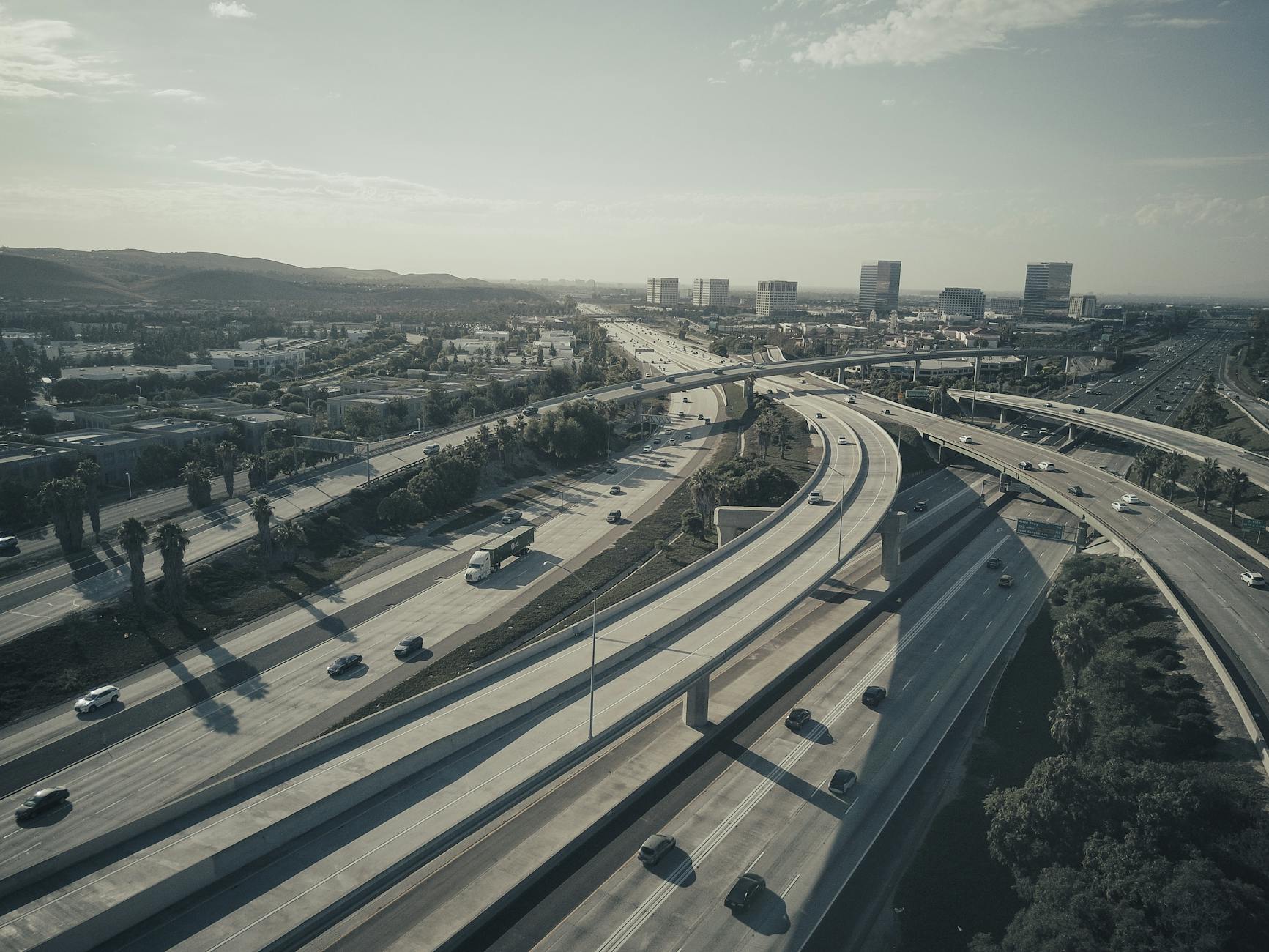
Merge Here: The 2,000-Year-Old Idea Behind Every American On-Ramp
Somewhere between your exit ramp and the drive-through, you are passing through history. Not metaphorically. The physical logic of the road underneath your tires — the straightness of it, the way it ignores local geography in favor of speed, the rest stops spaced at intervals that feel almost military — was worked out by Roman engineers roughly two thousand years before your GPS was manufactured.
This isn't a coincidence. It's a case study in how human beings, when faced with the same problem, tend to reach for the same solutions. And the problem, in both cases, was identical: how do you hold a large, fractious, geographically diverse nation together when it keeps trying to fall apart?
What the Romans Were Actually Building
The Via Appia — the Appian Way — was begun in 312 BCE and eventually stretched more than 350 miles from Rome to Brindisi on the heel of Italy's boot. It was the interstate highway of its era, and like all great infrastructure projects, it was sold on practical grounds while serving political ones.
Officially, the roads were about trade. And they were. Roman roads connected markets, moved grain, and let merchants operate across an empire spanning three continents. The economic case was real and the Romans made it loudly.
But the roads were also, fundamentally, about moving soldiers fast. Roman military doctrine depended on the ability to shift legions from one frontier to another before a local crisis became a permanent catastrophe. A road that let a merchant move olive oil from Spain to Rome in two weeks was, by definition, a road that could move a legion to a rebellion in the same timeframe. The commerce and the coercion were inseparable. They still are.
At its peak, the Roman road network covered an estimated 250,000 miles — a figure so large it's almost meaningless until you stand on one of the surviving stretches near Rome and look at the engineering. These weren't dirt tracks. They were layered constructions: a foundation of large stones, a middle course of smaller rubble, a top surface of fitted stone slabs, cambered to drain rainwater to the sides. Roman roads were built to last, and they did. Many European roads today follow routes the Romans surveyed.
Eisenhower's Sales Pitch (You've Heard It Before)
In 1956, Dwight Eisenhower signed the Federal Aid Highway Act, authorizing what would become the Interstate Highway System — 41,000 miles of controlled-access roads connecting every major American city. The project cost roughly $500 billion in today's dollars and reshaped the country more profoundly than almost any other peacetime initiative in American history.
The official justification? Commerce and defense. Sound familiar?
Eisenhower was explicit about the military rationale. He had watched the German Autobahn during World War II and understood what a high-speed road network meant for moving troops and equipment. He had also lived through the grinding difficulty of the 1919 Motor Transport Corps convoy, in which a military caravan took 62 days to cross the United States on roads that were, in many stretches, barely passable. The interstate system, in his mind, was as much a national security asset as a carrier fleet.
The commerce argument was equally familiar. Highways would connect markets, reduce shipping costs, and knit together a national economy that was still, in places, frustratingly regional. The economic case was real. And the roads did deliver on it.
What neither the Romans nor the Eisenhower administration fully advertised was the third thing infrastructure always does: it determines winners and losers. Roman roads enriched the cities they connected and quietly strangled the ones they bypassed. American interstates did the same thing in a single generation, hollowing out the downtowns of mid-sized cities while creating the suburbs, the trucking industry, and the fast food chain as we know it.
The Engineering Instinct Doesn't Change
Here's what makes this more than a fun historical parallel. The reasoning behind both projects — the actual logic used by Roman censors and American congressional committees — is nearly word-for-word identical across two millennia. Both emphasized speed of military movement. Both projected economic growth using optimistic multiplier estimates. Both required the displacement of existing populations and the overriding of local objections in favor of national interest. Both were celebrated as monuments to civilization at their completion.
That's not because Eisenhower was copying Rome (though he certainly knew the history). It's because the underlying problem is the same, and human beings working through the same problem with similar tools tend to converge on similar answers. The Romans didn't invent road-building any more than Eisenhower did. They both inherited an idea that goes back to the first time someone cleared a path through a forest because it was faster than going around.
What changes is the scale, the technology, and the politics. What doesn't change is the psychology: the belief that connection equals control, that speed equals power, and that the nation that can move fastest wins.
Where to Actually See This
If you want to stand inside this history rather than just read about it, the options are better than you might expect.
In Rome, the Via Appia Antica is a functioning archaeological park where you can walk or bike on original Roman paving stones. The ruts worn by two thousand years of cart wheels are still visible. It is one of the more quietly staggering experiences available to a traveler — the physical sensation of standing on infrastructure that is genuinely, provably older than Christianity.
In the United States, US Route 40 — the old National Road, which predates the interstate system by 150 years — traces a path from Baltimore to Utah that itself follows Indigenous trade routes of even greater antiquity. The road layers are literal: modern asphalt over 19th-century turnpike over paths worn by feet and hooves over centuries.
The next time you merge onto an interstate, consider what you're actually doing. You're using a solution that a Roman engineer would recognize immediately, justified by arguments a Roman senator would find completely familiar, to solve a problem that human societies have been trying to solve since the first time someone decided that getting somewhere fast was worth the cost of building the road to do it.
The past is not behind you. In this case, it's underneath you.