The Building That Disappeared Without Going Anywhere
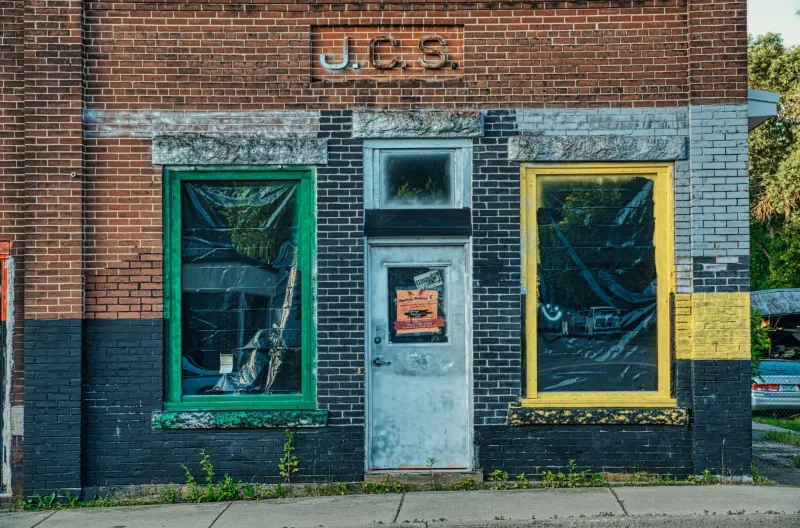
The wrecking ball is a dramatic instrument. It makes the news. It generates the petitions and the last-minute preservation fights and the photographs of facades coming down in clouds of dust. We understand demolition as loss because it's visible and irreversible and loud.
But there's a quieter erasure happening in American towns all the time, and it doesn't require a crane. It requires only a consensus — usually unspoken, rarely deliberate — to stop paying attention. Some of the oldest structures in America are currently standing, physically intact, in the middle of occupied blocks, in towns that have entirely forgotten they exist.
What Forgetting Actually Looks Like
It starts, usually, with something small. A storefront gets a new aluminum façade in the 1960s, the kind that was fashionable then and hideous now, covering the original brick and the original cornice line. The building doesn't change structurally. But its face changes, and faces are how we recognize things. The people who remembered the original brick are aging out. The people who grew up with the aluminum face have no memory to contradict.
Then the sign changes. The hardware store that occupied the ground floor for seventy years closes, and a cell phone retailer moves in with a new sign that covers the transom windows. Then the upper floors, which were once apartments and then were offices and then were empty, get a quick cosmetic renovation — new drywall over the original plaster, drop ceilings below the original tin. The bones of the building are still there. Everything that made it identifiable as a specific thing from a specific time is now behind something newer.
This is not vandalism. It's not even negligence, exactly. It's commerce operating on a short time horizon, which is what commerce almost always does. Each individual decision — the new façade, the new sign, the new interior — is rational given the information available to the person making it. The cumulative effect is the structural equivalent of a witness protection program.
The Psychology of Selective Preservation
Human memory is not an archive. It's an argument. Communities don't preserve everything; they preserve what they've agreed matters, and that agreement is always political in the broadest sense — it reflects whose history is considered worth keeping, whose era is considered worth commemorating, whose buildings are considered worth fighting for.
This is not a new dynamic. The ancient Romans built new temples on top of old ones with remarkable frequency, not because they lacked the space but because the new temple made an argument about the present that the old one couldn't. Medieval European towns routinely incorporated much older structures into newer construction in ways that made the older material invisible — not destroyed, just absorbed and forgotten. The impulse to selectively erase the past while physically retaining it is as old as the built environment.
What's specifically American is the speed of it. In a country where "old" often means "built before World War II" and where the cultural premium on newness has always been unusually high, the forgetting schedule runs fast. A building that was constructed in 1890 can be effectively erased from community memory within two or three ownership cycles — roughly fifty to seventy years — without a single structural change. All it takes is a community that stopped looking.
The Tells, If You Know What to Look For
The good news for anyone paying attention is that buildings hold their secrets imperfectly. The aluminum storefront from 1965 doesn't quite meet the original cornice line, leaving a gap that shows the older brick. The dropped ceiling in the renovated office is eight feet high, but the windows are ten feet tall — a proportion that makes no sense unless you understand what the room originally looked like. The fire escapes are bolted into masonry that predates the building's apparent age by several decades.
Architects and preservationists call this "reading" a building — the practice of looking at the physical evidence of a structure's history rather than accepting its current surface presentation. It's a skill that travels well. You can apply it in any American downtown, on any commercial block that looks generically mid-century, and find the older thing underneath.
In the older river towns of the Ohio Valley, this exercise is particularly productive. Towns like Marietta, Ohio, or Madison, Indiana, have commercial blocks where the street-level presentation is entirely mid-twentieth century but the upper floors retain Federal and Greek Revival detailing that dates to the 1830s and 1840s. The buildings are simultaneously invisible (nobody reads them as early nineteenth-century structures) and present (they're right there, occupying the same footprint they always have).
What We Agreed to Forget, and Why
The more interesting question isn't how buildings disappear from memory — the mechanics are fairly straightforward. The interesting question is which buildings get forgotten and which get preserved, and what that selection reveals about the community doing the selecting.
The pattern, in American towns, is fairly consistent. Buildings associated with industries or populations that fell out of social favor tend to disappear from memory fastest. The company town housing for immigrant laborers gets the aluminum façade treatment decades before the Victorian house of the mill owner. The buildings associated with Black economic life in segregated downtown districts get demolished or absorbed without commemoration at rates that dwarf the preservation energy devoted to comparable white-owned structures from the same era.
This isn't a conspiracy. It's just the ordinary operation of whose past a community considers worth the effort of remembering. The forgetting schedule is, at bottom, a values document — an unwritten record of what a town decided it wanted to be descended from.
The Practice of Looking
If you travel through American towns with any regularity, there's a habit worth developing: look up. Not metaphorically. Literally look up, above the storefront level, at the upper floors of commercial buildings on the main street. The ground floor is almost always the most heavily modified, the most thoroughly updated, the most aggressively presentable. The upper floors are where the original building survives.
Look at the window proportions. Look at the cornice details. Look at the brickwork patterns, which are often diagnostic — certain bonding patterns were common in certain decades, and a practiced eye can date a wall by how the bricks are laid. Look at the roofline against the sky, where modifications are hardest to hide.
What you're doing, when you do this, is refusing the forgetting schedule. You're insisting on seeing the building that's actually there rather than the building the current owner or the current era is presenting to you. It's a small act of historical stubbornness. It's also, it turns out, a pretty good way to see a town — not as it wants to be seen, but as it actually is, accumulated layer by layer, right there in front of you, waiting for someone to look.