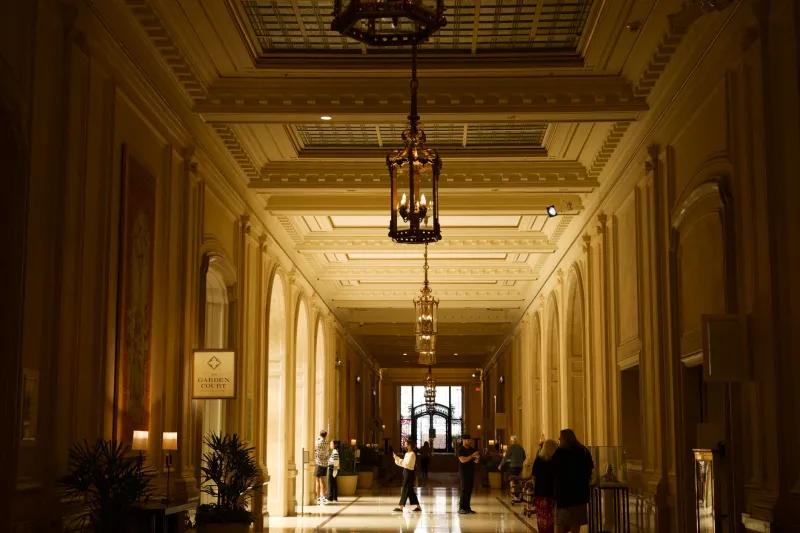
There's a particular kind of American hotel room that history has never bothered to name. It's not the bridal suite. It's not the corner room with the view of the capitol dome. It's the second-floor meeting room with the drop ceiling and the water-stained carpet and the folding tables pushed together to approximate a conference setup. It smells faintly of coffee that was made around nine and abandoned around ten. Nobody has ever written a book about it.
That's precisely why everything important happened there.
Anonymity as Infrastructure
Human beings have always understood something that historians are slow to acknowledge: the most consequential conversations require the least memorable settings. This isn't accidental. It's strategic. When labor organizers were quietly negotiating terms in the 1930s, they weren't doing it at the Palmer House's famous dining room, where every face was known and every table was watched. They were doing it at the kind of mid-tier commercial hotel where the staff turnover was high enough that nobody remembered who'd checked in on Tuesday.
This is a behavioral pattern older than the republic. Medieval merchants conducted sensitive negotiations in ordinary inns specifically because the setting signaled nothing. No one could read power or affiliation into a room that contained no symbols of either. The forgettable space was a tool — as deliberate a choice as any coded language or sealed envelope.
America inherited this logic and industrialized it. By the late nineteenth century, the country had developed an entire tier of commercial hotels — not grand, not cheap, just profoundly adequate — that served as the invisible operating system of the economy. The Gilded Age's famous robber barons got their portraits painted in drawing rooms. They made their actual decisions in hotel dining rooms in Cincinnati and St. Louis and Pittsburgh, in cities that were central to rail lines and therefore central to everything else.
The Convention Circuit Nobody Photographed
If you travel through the industrial Midwest today, you can still find the physical remnants of this infrastructure. The mid-sized cities that served as regional hubs — Dayton, Peoria, Akron — built commercial hotels at their downtown cores in the 1890s and early 1900s that were designed specifically for transactional anonymity. Not luxury. Transaction.
These buildings had certain consistent features. Multiple entrances, including at least one off an alley or side street. Ground-floor dining rooms with high-backed booths that provided acoustic privacy without requiring a private room. Meeting spaces that could be rented without requiring a name on the reservation — a room number would do. A bar positioned such that a man could nurse a drink while watching the lobby without being obviously visible from the front desk.
This wasn't coincidence. The architects who designed these buildings understood their clientele. Union officials, traveling salesmen negotiating exclusive contracts, political operatives assembling delegate counts before a convention, insurance executives arranging terms that would later be blessed by lawyers in mahogany offices — these men needed function, not grandeur. The grandeur was for afterward, when the deal was already done and it was safe to celebrate somewhere visible.
What the Plaques Don't Tell You
The historical marker problem in America runs deep. We are a culture that commemorates outcomes and ignores processes. We put plaques on the building where the treaty was signed, not on the hotel three blocks away where the negotiating positions were worked out over three days of bad coffee and worse sleep.
This means our physical historical record is systematically misleading. Walk through any American city and read the markers. They point you toward the ceremonial moments — the signings, the speeches, the inaugurations. The markers are almost never on the commercial hotels where the actual negotiating happened, because by the time the historians arrived, those hotels had either been torn down or converted into something else, and nobody had thought to document what happened in them because nothing official had happened in them.
The result is a version of history that looks like a series of sudden, clean decisions made by powerful people in impressive rooms. The messier truth — that most of those decisions were the product of iterative, informal, deniable conversations in thoroughly unremarkable spaces — doesn't survive in the built environment because the spaces weren't designed to survive. They were designed to be used and forgotten.
Finding the Real Room
If you're traveling through any American city with serious industrial or political history, there's a useful exercise. Find the grand hotel that everyone knows. Read the plaque. Then look at a map from roughly the same era and find what used to be within three or four blocks — the second-tier commercial hotels, the rooming houses that catered to traveling businessmen, the buildings that show up in old city directories as simply "hotel" with no further elaboration.
In Chicago, this means looking past the Palmer House and the Drake toward the string of commercial hotels that once ran along the streets closest to the old stockyards and the Board of Trade. In Washington, it means looking at the hotels that catered to lobbyists and congressional staffers rather than presidents and ambassadors. In Detroit, it means finding what stood near the auto company offices before the industry consolidated and moved its decision-making into corporate headquarters that were, ironically, designed to look as grand as the hotels they replaced.
You won't find many of these buildings still standing. Their anonymity was a commercial feature, not a preservation argument. When the economy moved on, they were the first to go — no constituency fought for them, because their value had always been invisible.
The Psychology Hasn't Changed
Here's what five thousand years of human behavior tells us: people have always needed a space that exists outside the official record. Not because they were doing something criminal — though sometimes they were — but because the official record imposes constraints that make honest negotiation impossible. You can't publicly retreat from a position you've publicly staked out. You can't explore an idea that might embarrass you if it gets reported before it's formed.
The second-rate hotel solved this problem architecturally. It provided physical proximity to power centers while maintaining social distance from them. It allowed the people who built America's economy and political structure to do the actual work of building it in a space where nobody was keeping score.
Next time you're passing through a mid-sized American city, look at what's left of the downtown commercial core. The building that's now a parking garage or a CVS or a slightly tired law office — look at the bones of it. Somebody made a decision in there once that you're probably still living with. They just didn't leave a plaque about it.