Where Democracy Goes to Make Deals: The Secret History of America's Most Powerful Waiting Rooms
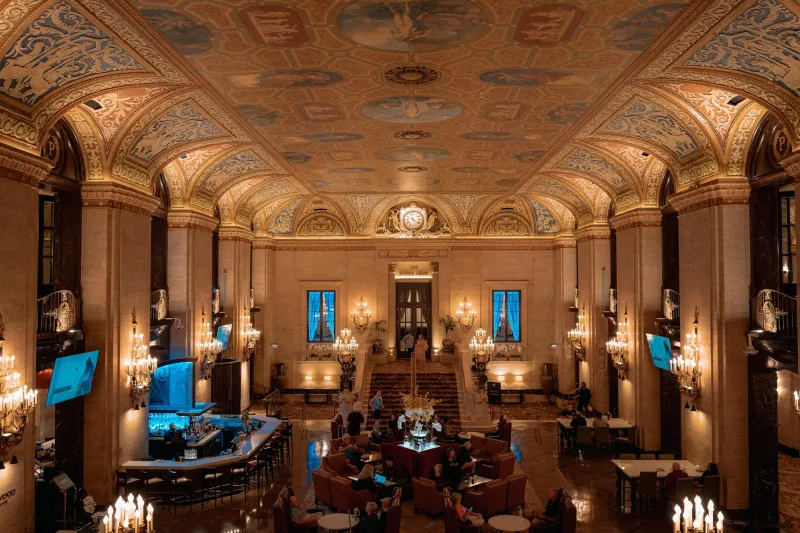
Walk into the Willard InterContinental in Washington, D.C., and you're standing in what might be America's most productive office building. Not because of the rooms upstairs, but because of the lobby you're standing in right now.
This is where Ulysses S. Grant coined the term "lobbyist" to describe the favor-seekers who cornered him during his evening brandy. Where Martin Luther King Jr. put the finishing touches on his "I Have a Dream" speech the night before the March on Washington. Where, according to persistent rumors, more than one presidential election was effectively decided before the first ballot was cast.
The Willard's lobby isn't unique in American history — it's the template.
The Architecture of Ambiguity
Hotel lobbies occupy a unique space in American social geography. They're public enough that anyone can enter, but private enough that conversations feel confidential. They're formal enough for serious business, but casual enough that deals don't feel like formal negotiations. They're neutral territory where enemies can meet without losing face.
This wasn't an accident. The great hotel architects of the 19th and early 20th centuries understood that they were designing more than waiting rooms — they were creating environments for power.
Consider the lobby of the Palmer House in Chicago, built in 1875. The architects deliberately created what they called "conversation islands" — clusters of chairs and sofas arranged to encourage small group discussions while maintaining visual privacy from other guests. The lighting was designed to be bright enough for reading contracts but dim enough for discretion. The acoustics were tuned to allow whispered conversations without carrying to neighboring seating areas.
Every element was calculated to facilitate the kind of informal negotiations that formal meeting rooms somehow discourage.
The Gilded Age's Unofficial Capitol
By the 1880s, America's hotel lobbies had become the shadow infrastructure of American politics and business. The lobby of the Fifth Avenue Hotel in New York was so central to Republican politics that it was known as the "Amen Corner" — the place where party decisions were made and ratified.
It was here that the details of the Compromise of 1877 were allegedly hammered out, effectively ending Reconstruction in exchange for Rutherford B. Hayes's presidency. The formal negotiations happened in government buildings, but the real work — the horse-trading, the favor-swapping, the delicate balance of interests that made a deal possible — happened in overstuffed leather chairs while waiters served brandy and cigars.
The hotel lobby provided something that no government building could: plausible deniability. If a deal went bad, everyone involved could claim they'd just happened to run into each other at their hotel.
Where Monopolies Were Born
The lobby of the Windsor Hotel in Denver was where the silver mining barons carved up Colorado in the 1890s. The Roosevelt Hotel in New York was where the aviation industry's early giants decided which routes belonged to whom. The Ambassador Hotel in Los Angeles was where Hollywood's studio system was designed, complete with the territorial agreements that would define the entertainment industry for decades.
These weren't conspiracy meetings in smoke-filled rooms — they were business conversations in well-lit public spaces. The genius of the hotel lobby was that it made backroom deals feel like chance encounters.
J.P. Morgan perfected this approach. Rather than summoning rivals to his office (which would look like intimidation) or meeting in their offices (which would look like weakness), he'd arrange to "accidentally" encounter them in the lobby of whatever hotel he was staying at. The casual setting disguised the calculated nature of the conversation.
The New Deal's Living Room
Franklin Roosevelt understood the power of hotel lobbies better than perhaps any president before or since. During the 1932 election, his campaign effectively operated out of the Biltmore Hotel's lobby in New York. Supporters, donors, and political operatives knew they could find Roosevelt's people there any hour of the day or night.
More importantly, Roosevelt used hotel lobbies as neutral ground for conversations that couldn't happen in the White House. When he needed to feel out opposition to a new policy, he'd have his surrogates test ideas in hotel lobbies across Washington. The informal feedback he received was often more valuable than formal polling.
The practice continued throughout his presidency. Some of the most important New Deal legislation was first sketched out on hotel napkins, refined in lobby conversations, and only then translated into formal proposals.
The Cold War's Neutral Zone
During the Cold War, hotel lobbies took on an even more crucial role as spaces where adversaries could meet without triggering diplomatic incidents. The lobby of the Hay-Adams Hotel in Washington became an unofficial embassy for Soviet officials who needed to communicate with their American counterparts outside formal channels.
The beauty of the hotel lobby was its deniability. If a Soviet diplomat was seen talking to an American official in the State Department, it was news. If they were seen talking in a hotel lobby, they were just two guests making small talk.
The Modern Lobby's Digital Evolution
Today's hotel lobbies serve the same function, just with better Wi-Fi. The lobby of the St. Regis in San Francisco is where tech deals get outlined before they're formalized in boardrooms. The Chateau Marmont in Los Angeles is where entertainment industry power brokers still hash out the details of projects worth hundreds of millions of dollars.
The fundamental appeal hasn't changed: hotel lobbies remain spaces where serious people can have serious conversations without the formal constraints that govern official meetings.
The Psychology of Productive Waiting
What makes hotel lobbies so effective for deal-making isn't just their physical design — it's their temporal nature. Everyone in a hotel lobby is temporarily displaced from their normal environment, which creates a unique psychological state. People are more open to new ideas when they're away from their usual context and constraints.
The lobby also imposes a subtle time pressure. Unlike office meetings, which can theoretically go on forever, hotel lobby conversations have natural endpoints. Someone's car arrives, or their dinner reservation calls, or they need to check in. This creates urgency without explicit deadlines.
The Waiting Room That Runs America
The next time you're sitting in a hotel lobby, look around. Those business travelers pecking at laptops aren't just killing time — they're participating in a tradition that's older than the skyscraper, more durable than any political party, and more influential than most government agencies.
They're using architecture to create opportunity, exploiting the psychology of neutral space to make deals that would be impossible in more formal settings. They're proving that sometimes, the most important room in the building is the one where people wait.
America's hotel lobbies aren't just where travelers pass through — they're where American power gets negotiated, one conversation at a time.