Left at the Door: What Abandoned Objects Know About American Departure
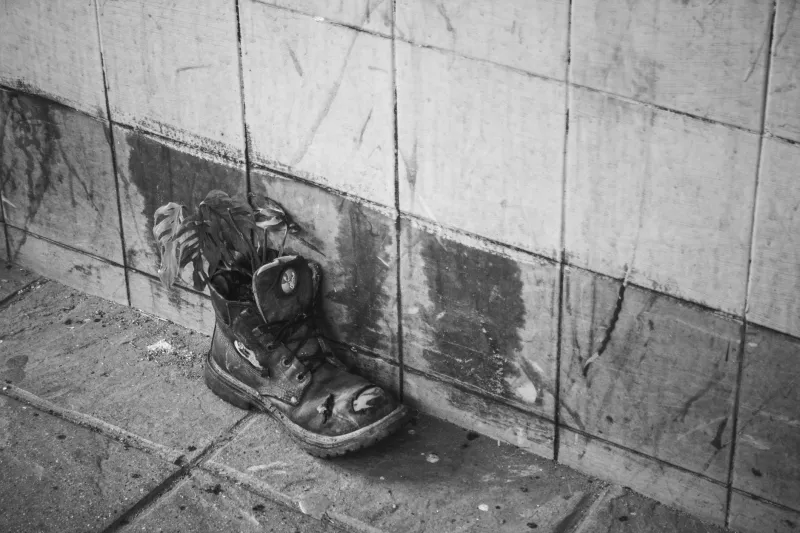
There's a particular kind of archive that doesn't live in a climate-controlled room. It doesn't have a finding aid or an accession number. It lives in the mud at the base of a canyon trail, in the crawl space of a foreclosed house in Detroit, in a locker at a Greyhound station that nobody ever came back to open. These are the things people left when they went — and they are, in their way, the most honest documents American history has ever produced.
No one abandons a possession without making a calculation first. That calculation is the history.
The Object Doesn't Lie
Historians have a phrase they use when talking about written sources: consider the author's intent. Every letter, every memoir, every newspaper account was shaped by someone who had a reason to frame things a certain way. The abandoned shoe has no such problem. It wasn't written for an audience. It wasn't preserved to make anyone look good. It sat in the desert because the person wearing it decided, at some specific moment, that carrying it further cost more than leaving it behind.
That moment — that exact calculation — is what researchers at places like the Smithsonian's National Museum of American History have spent decades trying to reconstruct from written records. The objects just hand it over.
Along the Southern Arizona desert corridors that have served as migration routes for generations, border researchers and humanitarian aid workers have catalogued tens of thousands of objects left in the brush: shoes worn through at the heel, children's backpacks, rosaries, laminated photographs. The shoes, specifically, are studied with almost forensic attention. The wear pattern tells you how far someone walked before that pair gave out. The size tells you something about age. The brand and country of manufacture tells you about economic circumstances at the point of origin. A single shoe contains a biography.
This isn't a new phenomenon. It's a very old human pattern wearing a new address.
What the Tenements Left Behind
When researchers began excavating the sites of former immigrant tenements in lower Manhattan in the late twentieth century — buildings that had been demolished and built over for a century — they found objects stuffed into walls, dropped between floorboards, left in the cavities of demolished hearths. Buttons from Eastern European garments. A child's shoe with a paper insole written over in Yiddish. A medicine bottle with a label in Italian.
These weren't heirlooms. Nobody packed them out because they weren't worth packing. And that's exactly why they matter. The things people kept were curated. The things people dropped were true.
The paper insole is particularly instructive. Someone — almost certainly a mother, based on the handwriting analysis done in subsequent studies — had written a child's name and a street address on a scrap of paper and tucked it into the shoe. Not a letter. Not a document. A contingency plan for a lost child in a city where you didn't speak the language and couldn't assume a policeman would help you. That single object tells you more about the psychological experience of immigrant arrival in 1890s New York than most of what was written about it at the time.
The Suitcase as Decision Log
The packed bag is in some ways even more revealing than what was dropped. At the National Archives and at dozens of state historical societies across the country, researchers have catalogued the contents of bags and trunks carried by people during the Great Migration — the decades-long movement of Black Americans from the rural South to northern cities that reshaped the country between roughly 1910 and 1970.
What people brought is a record of what they believed they were moving toward. What they left is a record of what they'd given up on.
Family Bibles appear constantly in the inventories. Tools of specific trades — a seamstress's measuring tape, a barber's kit — appear with remarkable frequency, which tells you something about what people thought they could rebuild and what they thought they couldn't. Photographs of the dead appear more often than photographs of the living, which tells you something about grief and something about the specific anxiety of leaving behind people who couldn't come.
Notably absent from most of these bags: anything that marked a person as belonging to a specific Southern community. No church membership documents. No letters of reference from white employers, even when those letters might have helped with housing or employment up north. The decision to leave that paper behind was its own statement, made in private, that the whole previous chapter was being closed.
The Foreclosure Record Nobody Filed
More recently, researchers studying the aftermath of the 2008 housing crisis have found a new version of this same phenomenon in abandoned homes across the Rust Belt and Sun Belt alike. When families lost houses to foreclosure, they frequently left behind objects that reveal the specific architecture of their hope and its collapse.
Baby furniture assembled and never used. Home improvement supplies — tile, paint, lumber — purchased for renovations that never happened. In one documented case in Cleveland, a researcher found a wall in a foreclosed home that had been half-painted in a cheerful yellow, the roller still in the tray, dried stiff. Someone had stopped mid-stroke. The date of foreclosure filing was two days later.
Human psychology doesn't change. The Roman archaeologists excavating Pompeii found bread still in the ovens. The psychology of interrupted ordinary life — the moment when the future stopped arriving — looks the same in every century and every ZIP code.
Reading What You Pass
For travelers, this is the argument for slowing down in the places that feel empty. The abandoned gas station at the edge of a dying town, the derelict farmhouse visible from the interstate, the old train depot with its windows boarded — these aren't gaps in the landscape. They're primary sources.
The next time you pass through a place that's been left, look at what's still there. Not as decay, not as aesthetic ruin photography, but as evidence. Ask what it cost to leave that thing behind. Ask what someone thought was worth more than it.
The answer is the history. And unlike the version in the textbook, nobody edited it before you arrived.