Nobody Buys a Souvenir Spoon to Impress Anyone — Which Is Exactly Why It's the Most Honest Thing in Your Drawer
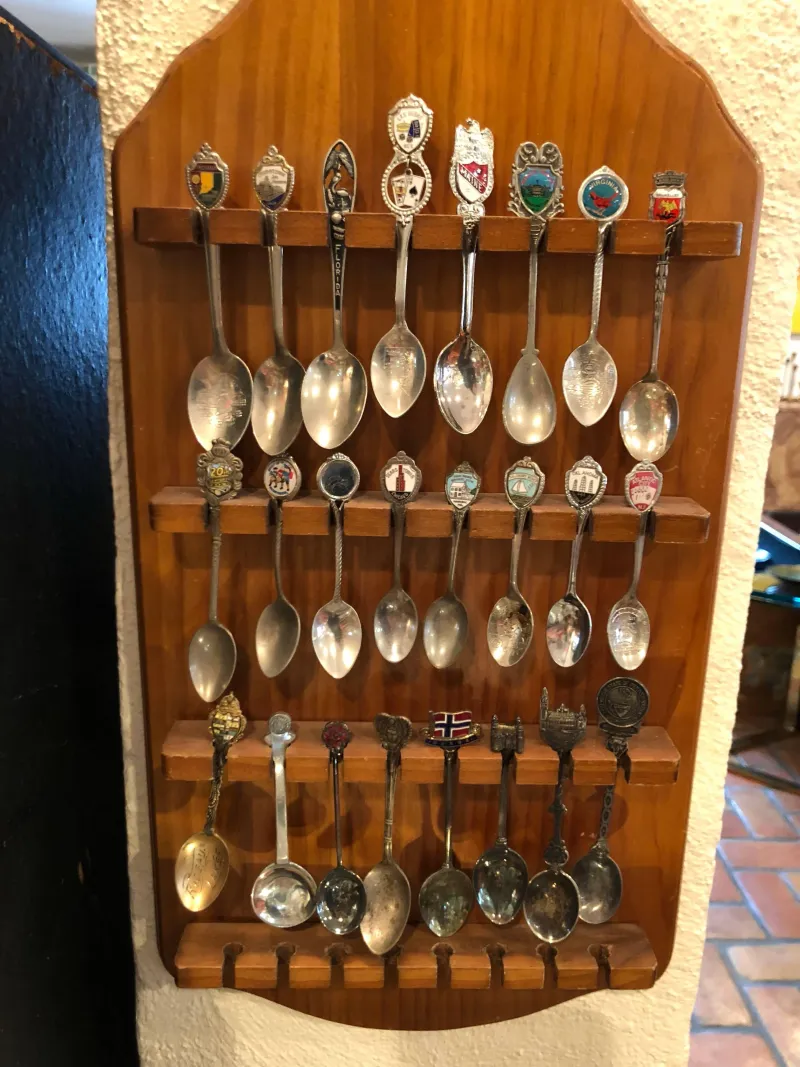
Photo: vintage souvenir spoon collection display enamel travel landmarks, via a.1stdibscdn.com
Somewhere in your mother's house — or your grandmother's, or a box you inherited and haven't opened since the funeral — there is a spoon. It has a tiny enamel Grand Canyon or a plastic-encased New Orleans streetcar or the word WISCONSIN in relief across the bowl. Nobody uses it to eat. Nobody displays it in a formal dining room. It is, by the standards of anyone with taste, a joke.
It is also the most honest travel document America produces.
The Impostor Hierarchy of Travel Mementos
Think about the full range of things people bring home from a trip, arranged by how much they're lying.
At the top: the photograph printed and framed as "art." Maybe it is art. Maybe it's a shot you took at golden hour with four hundred other people standing in the same spot. The framed photo says I have an eye. Does it? Unclear.
Next: the artisanal object. The handwoven textile, the ceramic bowl, the piece of local pottery. These say I shop thoughtfully and support makers. Sometimes true! Often it's factory-made an hour from your house and shipped to a wholesale showroom.
Then: the vintage find. The flea market print, the retro sign. Says: I have taste that transcends the present. Frequently says instead: I paid triple because it was within walking distance of my hotel.
And at the very bottom of the hierarchy, the most mocked object in American consumer culture: the souvenir spoon, the magnet, the shot glass, the keychain. Mass-produced. Identical in spirit to the one sold at every truck stop in the region. Purchased in under ninety seconds for less than the price of lunch.
And here's the thing — nobody pretends otherwise. That's the honesty. Nobody buys a souvenir spoon to signal discernment. You buy it because you were in a place, and you wanted proof, and this was the cheapest, fastest, most unambiguous way to get it. There is no performance. There is no caption. There is just: I was here, and I wanted to keep some of it.
Every other souvenir is negotiating with an audience. The spoon is not. It's a diary entry written in metal.
A Thousand Years of Wanting Proof
The impulse is ancient, and the historical record is unambiguous about it. Medieval pilgrims traveling to Santiago de Compostela or Canterbury bought badges — small cast tokens of lead or tin, stamped with a shell or a saint, sewn onto hats and cloaks. They served as proof of completed pilgrimage, sure, and sometimes carried blessings. But mostly they were souvenirs: cheap, mass-produced, slightly embarrassing trinkets that said I made the journey. Archaeologists dig them up by the thousands.
The Grand Tour of the 1700s produced the same behavior in richer packaging — young aristocrats hauling home crates of miniature reproductions of Roman ruins, little bronze copies of statues they'd seen for eleven minutes. The Grand Canyon shot glass is the direct descendant of the pilgrim badge. The technology changed; the compulsion didn't.
American tourism industrialized it. The late 19th century saw the rise of the spoontique trade — factories in the Northeast churning out stamped silverplate spoons for every town with a courthouse, a falls, or a claim to fame. nickel-plated proof, sold from glass cases in hotel lobbies. The spoon became the first truly democratic souvenir: affordable to anyone who could afford the trip at all.
The Same Compulsion Runs the Whole Industry
Here's where the spoon stops being a joke and becomes a key. The global travel economy runs on some enormous number of dollars annually — call it two trillion, call it whatever the economists say this year — and strip away the flights and the hotels and what you find underneath is the same engine that drove the medieval badge trade: the need to convert an experience into an object, because experiences evaporate and objects don't.
Every travel purchase is downstream of that anxiety. The upgrade hotel room, the food tour, the guided hike — a portion of every one of those dollars is buying proof. Proof for the social feed, proof for the memory, proof against the creeping suspicion that you'll return home and the trip will dissolve into nothing but a line on a statement.
The spoon just doesn't lie about it.
Read Your Drawer Like an Archive
This is, in the end, why we study this stuff. Human psychology hasn't changed in five thousand years — the pilgrim at Canterbury's shrine and the tourist at the Grand Canyon gift shop are running identical software. And the souvenir spoon, precisely because it makes no claim to artistry or taste, is the cleanest record we have of what travel actually feels like from the inside: the desire to hold onto something, anything, before the moment closes.
So the next time you're in a gift shop and you see the rack of spoons, don't sneer. Buy one. In fifty years, someone opening a drawer will know exactly who you were, where you went, and what you wanted — no filter, no caption, no pretense.
That's more than most documents can say.