Nowhere to Be, Nowhere to Go: The Transit Hall as America's Original Town Square
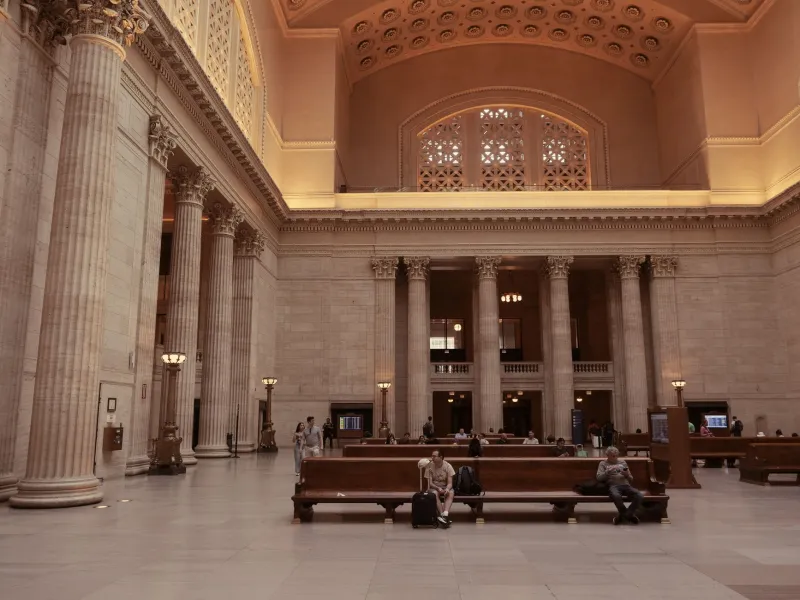
The architects who designed Grand Central Terminal in 1913 were thinking about traffic flow. They drew ramps instead of stairs to keep crowds moving. They calculated ceiling heights for acoustics and light. They were solving an engineering problem: how do you move two hundred thousand people a day through a single building without killing anyone?
What they accidentally built was something else: one of the most consequential public spaces in American history. A room where you could not avoid strangers. A room where information moved faster than the newspapers that reported it. A room where the social order was simultaneously enforced by architecture and undermined by proximity.
They were trying to build a train station. They built a forum.
The Accidental Architecture of Equality
Public space in American history has almost always been conditional. The town common was, in practice, for certain people. The courthouse square belonged to whoever ran the courthouse. Even churches sorted their congregants by wealth and standing, literally — better families rented the better pews.
The transit hall was different, and the difference was structural. You couldn't build a waiting room that worked only for the people you approved of. The train didn't negotiate. If someone had a ticket, they were in the room. And so, in the waiting rooms of major American terminals from roughly the 1840s onward, something unprecedented happened: people who would never otherwise share physical space were forced to share it.
This is not to romanticize what was often an uncomfortable and sometimes hostile experience. Railroads and bus companies went to considerable lengths to re-impose the social order inside their terminals — separate waiting rooms for Black passengers were standard across the South and common in the North well into the twentieth century. The effort itself tells you something. The very fact that railroads felt they needed to architecturally segregate their waiting rooms confirms that the transit hall, left alone, tended toward an uncomfortable mixing that the surrounding society wasn't ready for.
The waiting room was subversive by default. It took active effort to make it otherwise.
Information Moves at Departure Speed
Before the telegraph, before the telephone, before any of the infrastructure we associate with mass communication, the transit hub was how information traveled in America. Not just because people carried news when they traveled — though they did — but because the waiting room was where people who were about to travel and people who had just arrived occupied the same space simultaneously.
The incoming traveler from three states away knew things the local paper wouldn't print for a week. The person waiting for the afternoon departure had information about local conditions that the arriving traveler needed. In the gap between those two bodies of knowledge, the waiting room functioned as a continuous, self-organizing news exchange.
Tavern keepers had understood this for centuries — the previous article in this genre practically writes itself — but the transit hall scaled it. A major train station in a city like Chicago or St. Louis in the 1880s was processing information from dozens of incoming routes simultaneously. The rumors that circulated in those waiting rooms about crop prices, political developments, labor disputes, and business conditions were, in aggregate, a more current and accurate picture of the national situation than most newspapers could provide.
Politicians knew this. Labor organizers knew it. So did con artists, which tells you something about the value of the information being exchanged.
The Bench as Stage
Transit halls are, architecturally, theaters. They have a floor, they have a ceiling, they have rows of seating oriented toward a point of action (the departure board, the ticket window, the gate). And like theaters, they produce performance.
The behavior that emerges in transit waiting rooms is distinct from behavior in almost any other public space. People are suspended between identities — they've left wherever they came from but haven't arrived wherever they're going. This in-between state, which anthropologists call liminality, loosens the normal social scripts. People talk to strangers they would never approach on the street. They share information they'd normally guard. They cry in public. They make decisions.
The historical record of American transit halls is full of moments that could only have happened in that specific psychological suspension. The labor organizer who recruited for the union in the Chicago rail yards waiting room in 1919, targeting workers in transit who were temporarily outside their usual social networks and therefore briefly open to a pitch. The civil rights activists in the early 1960s who chose bus terminals specifically because the forced proximity of the waiting room made their presence impossible to ignore. The immigrant families in the great halls of Ellis Island's ferry terminal who encountered, for the first time, Americans of backgrounds completely unlike their own, and began the long process of becoming American themselves partly through that encounter.
None of these things were designed into the architecture. All of them emerged from it.
What Replaced the Waiting Room
The decline of the American transit hall as a meaningful public space tracks almost exactly with the rise of the private automobile and, later, the airport as the dominant form of long-distance travel. Both replacements are architecturally hostile to the accidental community that made train stations and bus terminals function as social spaces.
The car is, by design, a room for one household. The airport is a transit hall that has been so thoroughly commercialized and security-stratified that the conditions for genuine public exchange barely exist. You move through it in a channeled stream. You sit in gate areas organized by destination, which means you're already pre-sorted by where you're going rather than thrown together randomly. The social mixing that happened in the old waiting rooms doesn't happen at the gate for the flight to Phoenix.
What we've lost isn't just a mode of transportation. It's a type of space. A space where you couldn't choose your company, couldn't filter your information stream, couldn't avoid the person who looked nothing like you and was going somewhere you'd never been.
Why the Building Still Matters
The great transit halls that still stand — Union Station in Washington, D.C., 30th Street Station in Philadelphia, Union Station in Chicago — are worth visiting not as nostalgia objects but as working hypotheses. What did it do to American social life to have spaces like these at the center of every city? What did it cost to lose them?
Stand in the main concourse of 30th Street Station on a weekday afternoon, when it's busy enough to feel like itself, and pay attention to what's happening around you. People are talking to strangers. Information is moving laterally across the room in ways that aren't organized by any platform or algorithm. The social order is present but porous.
This is what a forum feels like. It always has. The Romans built theirs in marble too.