Kidney Pools and Windowless Lobbies: How to Date Any American Motel Before You Even Check In
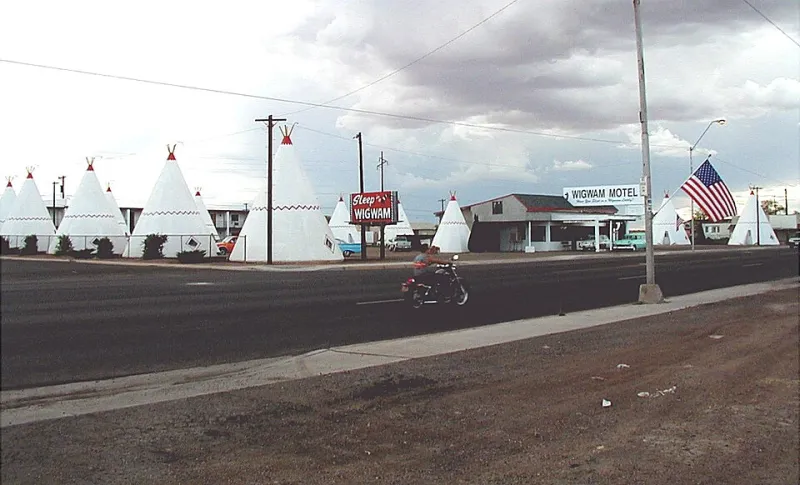
Photo: Unknown authorUnknown author or not provided, Public domain, via Wikimedia Commons
Every road-tripper develops the skill eventually: you pull into a parking lot at dusk, and before you've seen a single room, you already know roughly what year this place was built. Not renovated — built. It's not magic. It's architecture, and like tree rings, motel design records the exact anxieties of the moment it went up.
Here's the field guide.
The 1930s–40s: The Cabin Cluster
The earliest auto camps and motor courts weren't buildings so much as a row of detached cabins facing a shared office. Look for individual units, steep little gable roofs, and a central shack where the manager lived. The tell: the whole layout is defensive. Americans in the early automobile era didn't yet trust the strangers a highway brings to the door, so each family got its own freestanding box with its own entrance and, ideally, its own parking spot in front. The architecture is basically saying: you don't have to walk past anyone's door.
The 1950s: The Neon Promise
Postwar prosperity plus the Interstate Highway Act turned the motel into big business, and the design language got loud. The tells:
- Neon signage with animated elements. A diving lady, blinking stars, an arrow pointing to VACANCY. The 1950s motel was competing for attention from cars moving 60 miles an hour, and the sign was the entire marketing department.
- The carport. Not a parking lot — a covered structure attached to the rooms. The automobile had graduated from novelty to family member and deserved shelter.
- Cantilevered canopies and boomerang angles. Everything swooshes. This is Googie optimism, the same design DNA as the diner down the road.
- A lobby you can see into. Glass, light, openness. The fear of the stranger was fading; the motel was now selling itself as friendly.
The 1960s: The Kidney Pool
If you see a swimming pool shaped like a kidney bean, you are standing in the sixties. This is the single most reliable ring in the tree.
The kidney pool came out of mid-century modern landscape design — Thomas Church's 1948 Donnell Garden in California made the form famous — and it swept the motel industry because it looked organic, photographed well on postcards, and wrapped around a patio or lounge area in a way a rectangle couldn't. The pool stopped being a swimming facility and became a set. Families didn't come to swim; they came to be seen lounging by a curvy blue shape with a drink. The pool photograph became the motel's entire advertising strategy.
Other sixties tells: two-story buildings with exterior walkways and railing balconies, plastic lawn chairs in tropical colors, and room numbers in that unmistakable loopy script.
The 1970s: Closing In
The seventies motel gets defensive again, but for economic reasons rather than social ones. Energy costs, rising insurance rates, and urban decline produced:
- Windowless or nearly windowless lobbies. Security, climate control, and cheap construction all pointed the same direction. If the lobby has the ambience of a DMV waiting room, guess the decade.
- Interior corridors. The big paradigm shift — you enter through a central hallway, never outside. Great for climate control, terrible for romance, and the reason every seventies motel hallway smells like carpet cleaner and chlorine.
- Wood paneling, orange shag, and a lamp bolted to the nightstand. The bolted lamp is a security decision disguised as a design choice. Somebody, somewhere, was stealing lamps.
The 1980s–90s: The Chain Smile
Corporate standardized motels flatten the regional character, but the era still leaves fingerprints: exterior stucco in beige or mauve, a breakfast nook carved out of what used to be a lobby lounge, and the first appearance of the continental breakfast bar — the moment the industry decided the morning meal was a cost center to be minimized.
Why This Matters More Than It Should
It's tempting to file this under roadside trivia. But think about what you're actually reading. Every one of these design choices encodes a psychological fact about the people who built it. The cabin cluster encodes fear of strangers. The neon sign encodes optimism and the automobile's conquest of American life. The kidney pool encodes leisure as performance. The windowless lobby encodes anxiety about crime and cost.
Commerce always does this. Buildings are the most honest documents any era produces, because nobody sets out to write a manifesto — they just set out to fill beds, and in doing so they leave a record of exactly what they feared and what they wanted. Five thousand years from now, an archaeologist could reconstruct postwar American anxieties from motel floor plans alone.
You can do the same reconstruction on your next drive. Pull in, look at the pool, look at the lobby windows, look at the corridors. The building will tell you what year it's from, and if you let it, it'll tell you what the country was worried about that year too.
Then check in, put down your bags, and sleep like the five thousand years of travelers before you.