Built to Lose: The American Towns Still Fighting Wars They Lost a Century Ago
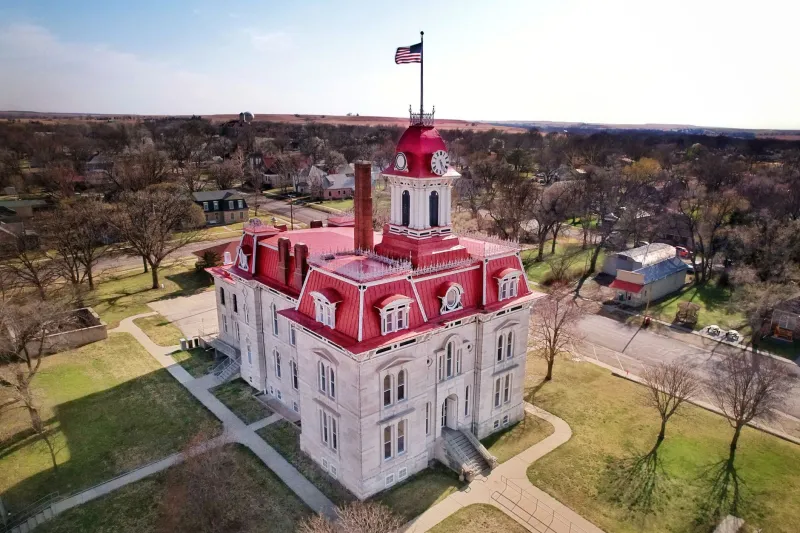
The Courthouse That Declares War on Yesterday
Stand in the town square of Pawnee City, Nebraska, and you're looking at one of America's most expensive architectural arguments. The courthouse there—a towering Victorian monument that cost more than the entire town's annual budget when it was built in 1878—wasn't designed to serve the legal needs of a farming community. It was designed to prove a point that no one was listening to anymore.
 Photo: Pawnee City, Nebraska, via dk2r6yr6ocwr8.cloudfront.net
Pawnee City had been promised the county seat, then lost it to a rival town through what locals still describe as "political maneuvering." The courthouse was their response: a building so grand, so obviously superior to anything the actual county seat could construct, that surely the decision would be reversed. It wasn't. The courthouse still stands, a limestone monument to the psychology of people who build their way out of losses they can't accept.
This pattern repeats across the American interior with mathematical precision. Towns that lost railroad routes built train stations anyway. Communities bypassed by highways constructed elaborate welcome centers for traffic that would never come. Cities that lost state capital competitions erected government buildings that housed no government.
The human psychology driving this behavior hasn't changed since the first civilization built a temple to a god who'd stopped answering prayers. When people can't control outcomes, they control symbols. When they can't win arguments, they construct monuments to their position.
The Architecture of Unfinished Business
Drive through Kansas, Nebraska, or the Dakotas, and you'll encounter dozens of these grievance landscapes: towns whose entire built environment tells the story of a single catastrophic defeat they're still trying to appeal. The buildings themselves become evidence in a case that's never been closed, architectural briefs filed with a court that no longer exists.
Take Nicodemus, Kansas, founded by freed slaves who were promised railroad access that never materialized. When the tracks went to a competing town, Nicodemus didn't fold—it doubled down. The community built a hotel grand enough for railroad executives, a main street wide enough for rail traffic, and commercial buildings designed to serve the regional hub they'd been promised they would become.
 Photo: Nicodemus, Kansas, via lid.zoocdn.com
The railroad never came. The hotel never hosted the guests it was designed for. The wide streets now frame empty lots where the prosperity was supposed to arrive. But the buildings remain, each one a physical argument that the original decision was wrong, that justice delayed isn't justice denied, that someday the trains will realize their mistake and turn around.
The Economics of Staying Mad
What's fascinating about these grievance towns isn't just that they were built around losses—it's that they've sustained themselves for generations on the energy of being wronged. The original participants in these disputes died decades ago, but their descendants continue to maintain the architectural evidence of injustices they never personally experienced.
This creates a peculiar local economy based on inherited outrage. Main Street buildings are preserved not because they're historically significant or economically viable, but because they represent proof in an argument that's been passed down like family heirlooms. Demolishing them would feel like admitting defeat in a fight their great-grandparents started.
The psychology here follows patterns that would be familiar to anyone who's studied feuding cultures throughout history. The original injury becomes secondary to the act of remembering the injury. The buildings stop being functional architecture and become ritual objects, maintained not for their utility but for their symbolic value in an ongoing dispute.
The Train Station That Sued the Railroad
In Dodge City, Kansas, there's a train depot that was built after the railroad left town. The community had been promised a major rail junction, then watched the tracks get rerouted to Garden City through what they considered corporate corruption and political favoritism. Their response was to build the depot anyway—not for trains, but as evidence.
 Photo: Dodge City, Kansas, via naukamon.eu
The building was designed to demonstrate what the railroad company was missing by not choosing Dodge City. Every architectural detail was calculated to prove that they'd made the wrong decision: the platform was longer than Garden City's, the waiting rooms more elegant, the freight facilities more sophisticated. It was a train station as lawsuit, a building designed to shame the Santa Fe Railway into reversing its route decision.
The railroad never returned. The depot became a museum, then a community center, then a venue for the kind of wedding receptions that small Kansas towns host when they're trying to prove they're still viable communities. But its original function—as a monument to being wronged—remains unchanged.
The Federal Building That Houses No Federal Agencies
Some of the most psychologically revealing architecture in America can be found in towns that lost federal designation competitions. When Yankton, South Dakota, was passed over as territorial capital, local boosters didn't accept the decision as final. They built a territorial capitol building anyway, complete with legislative chambers, executive offices, and judicial facilities.
The building was designed to demonstrate that the federal government had made an administrative error, that Yankton was obviously the superior choice for territorial governance, and that once officials saw the facilities they'd built, the decision would be reconsidered. It was architecture as political lobbying, a limestone argument for reversing a bureaucratic decision.
The territorial government never moved to Yankton. The capitol building became a school, then a museum, then a community center. But walk through it today, and you can still see the architectural confidence of people who believed they were constructing a temporary solution to a bureaucratic misunderstanding that would surely be corrected.
The Psychology of Permanent Temporary
What these buildings reveal about American psychology is our persistent belief that defeats are temporary and victories are earned through persistence rather than acceptance. The towns that built them weren't just responding to specific losses—they were expressing a fundamental American conviction that outcomes can be changed through effort, that justice delayed is justice that's still coming, that the right building in the right place will eventually attract the right attention.
This psychology has created a landscape of architectural arguments scattered across the rural Midwest: courthouses that argue for justice, train stations that argue for commerce, capitols that argue for governance, and hotels that argue for prosperity. Each building represents a community's refusal to accept that some competitions end permanently, that some decisions can't be appealed, that sometimes the other town actually was the better choice.
The Towns That Won't Admit They Lost
The most fascinating aspect of these grievance landscapes is how they've evolved from expressions of temporary disappointment into permanent features of local identity. The original defeats have become sources of pride, evidence that the community has principles worth maintaining even when maintaining them is economically irrational.
Visit these towns today, and you'll find residents who can recite the details of railroad disputes that happened before their great-grandparents were born, who maintain courthouse grounds for a county seat they lost in 1887, who preserve train depots for railways that haven't run passenger service since the Eisenhower administration.
They're not preserving history—they're preserving arguments. The buildings have become physical manifestations of a psychological state that's been passed down through generations: the conviction that being right matters more than being successful, that some principles are worth maintaining even when no one's paying attention anymore.
Drive through these towns, and you're touring the architectural evidence of a distinctly American form of stubbornness. These aren't just buildings—they're monuments to the psychology of people who respond to defeat by building bigger, who answer rejection by constructing proof of their worthiness, who transform losses into landmarks that will outlast everyone who remembers what they were built to prove.