The Window Tax Was Real and So Was Everything You've Paid for a View Since Then
The Window Tax Was Real and So Was Everything You've Paid for a View Since Then
The Airbnb listing says "partial ocean view" and charges forty dollars more per night than the identical unit facing the parking structure. You consider this for a moment, decide the partial ocean view is worth it, and book the more expensive room. You feel, briefly, like you've made a sophisticated choice.
You have made the same choice that travelers have been making since Tudor England. The specific technology — the app, the credit card, the instant booking — is new. The transaction is ancient.
The premium window is one of the oldest upsells in the hospitality industry, and tracing its history reveals something interesting not just about how inns and hotels have always operated, but about what human beings have always believed they were purchasing when they paid extra for a better view.
Light Was a Luxury Before It Was a View
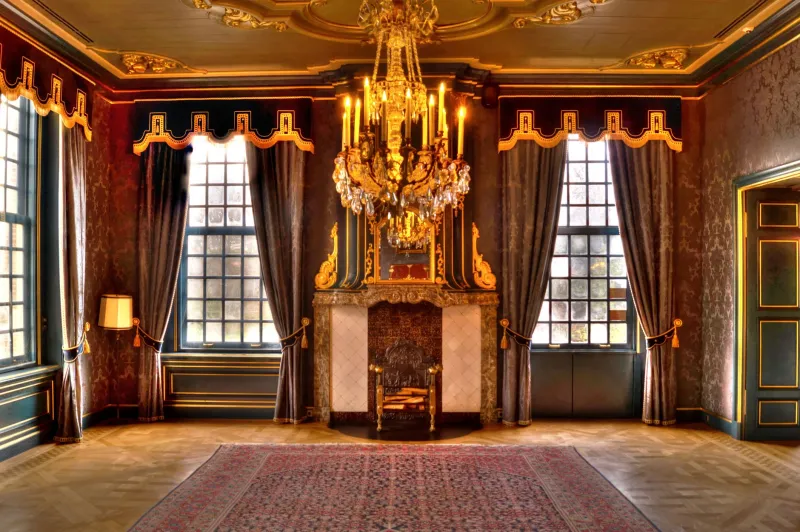
Before the view premium, there was the light premium. In medieval and early modern European buildings — the architectural tradition that shaped American hospitality infrastructure — windows were expensive to build, expensive to glaze, and expensive to maintain. Glass was a luxury material. A room with multiple large windows wasn't just pleasant; it was a demonstration of wealth.
The coaching inns that dominated English travel from roughly the 1500s through the early 1800s were organized around a clear hierarchy of rooms. The best rooms faced the courtyard — quieter than the street, better for sleeping, and positioned to catch morning light. The worst rooms faced the stable yard or the alley, smelled accordingly, and got whatever light was left over. The price difference was significant and universally understood.
American travelers who crossed the Atlantic brought this framework with them, and the colonial inns that appeared along the post roads of the Eastern Seaboard reproduced it almost immediately. The better rooms in a colonial ordinary weren't just larger. They were positioned. A room facing the main road offered more light and the mild entertainment of watching traffic. A room tucked into the back of the building offered neither.
Nobody called it a "view premium." It was just understood that some rooms were better than others, and better cost more.
England's Window Tax and What It Revealed
In 1696, the English government did something that accidentally documented the entire psychology of window premiums in a single piece of legislation. The Window Tax — a property tax based on the number of windows in a building — was intended to raise revenue in a way that roughly correlated with wealth, since richer people had bigger houses with more windows.
What it actually did was prove how much people valued light and views by showing how far they'd go to protect access to them. Wealthy homeowners paid the tax without flinching. Middle-class owners bricked up windows to reduce their tax burden — a decision visible on thousands of English buildings to this day, the blocked-up rectangles in old brick facades marking where light used to come in.
The Window Tax didn't reach the American colonies directly, but it shaped the architecture of the buildings that American hospitality was modeled on, and it illustrated something important: access to light and views was valuable enough to tax, worth paying significant money to maintain, and the hierarchy of who got more of it was already deeply embedded in how buildings were designed and priced.
The Grand Hotel Era and the View as Status Object
The great American hotels of the Gilded Age — the Palmer House in Chicago, the Palace in San Francisco, the Waldorf in New York — industrialized the view premium in ways that would be recognizable to any modern traveler.
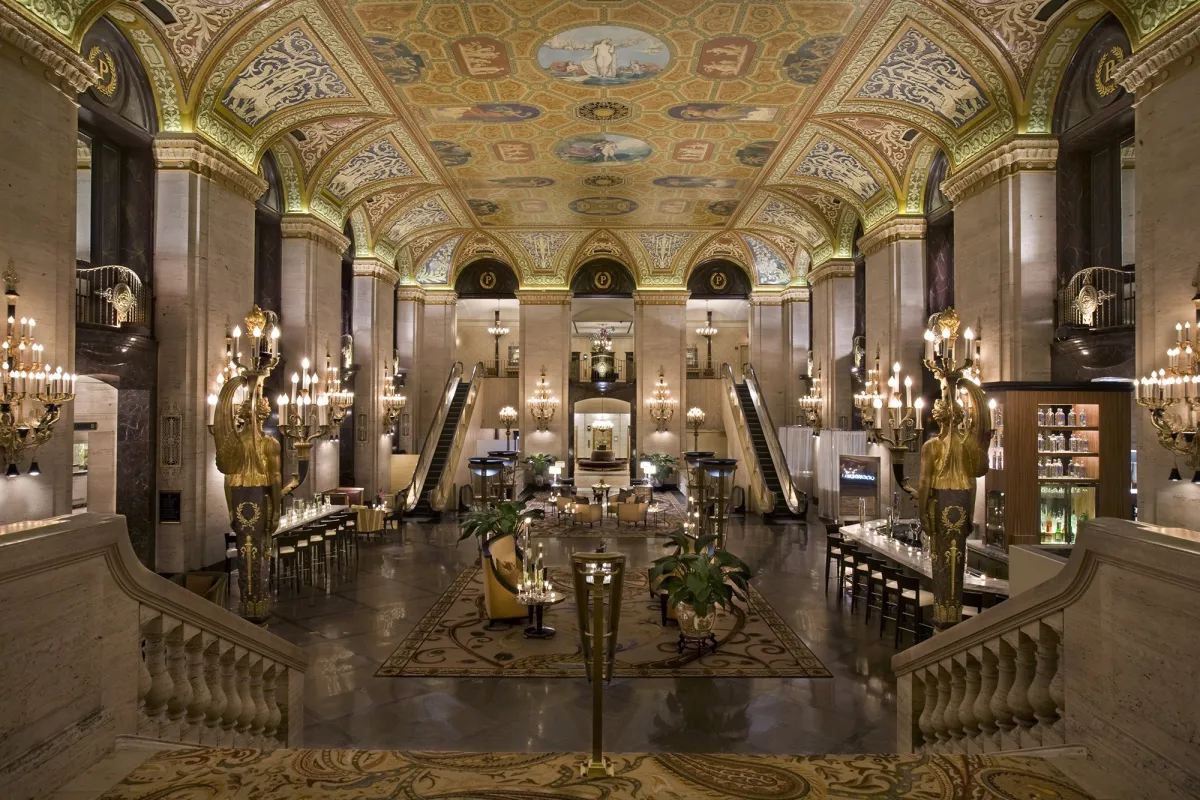 Photo: Palmer House, via s3.amazonaws.com
The top floors commanded the highest prices, partly because of the view and partly because the view was inseparable from status. Being seen to occupy a high floor, to look down at the city from a position of literal elevation, was part of what guests were purchasing. The view wasn't just scenery. It was a social statement about one's position.
This is the part that tends to get lost in the modern transaction. When you pay extra for the corner room with the skyline view, you're not just buying pixels of scenery. You're participating in a status performance with a history that runs through the Gilded Age hotels, through the coaching inns of Tudor England, all the way back to the first person who noticed that some rooms were better positioned than others and charged accordingly.
The hotel architects of the late 1800s understood this intuitively. They designed buildings with the explicit goal of creating a hierarchy of views — not just because some rooms had better sightlines, but because the existence of a premium view made the standard rooms feel like a reasonable compromise rather than a deprivation. The ocean-view suite makes the parking-lot room tolerable. Without the comparison, the parking-lot room is just a bad room.
The Partial Ocean View and the Psychology of Almost
Modern hospitality has refined this further with a category that would have impressed even the most cynical Gilded Age hotel manager: the partial view.
The partial ocean view — visible from one corner of the balcony if you stand at the right angle and the neighbor's palm tree isn't swaying — is a masterpiece of monetizing aspiration. It's not the view. It's the proximity to the view. You're paying for the possibility of the thing rather than the thing itself.
This works because what people are actually purchasing when they pay for a view has never been the scenery. It's the feeling of having chosen well. Of having secured something better than what was available to someone who didn't pay attention, didn't know to ask, didn't value the experience enough to spend a little more.
The view is proof of a decision. The partial view is proof of an aspiration.
Research on consumer psychology has documented this pattern in everything from wine pricing to hotel room selection: people use price as a signal of quality, and they use the act of paying more as evidence of their own good judgment. A traveler who books the ocean-view room has not just bought a room. She has confirmed something about herself.
This is not a criticism. It's the mechanism. It's been the mechanism for four hundred years.
What the Architecture Is Actually Telling You
When you walk into a hotel today and notice that the rooms on the upper floors facing the park cost twice what the interior rooms cost, you're reading a document. The building is telling you, in the language of price differentials and floor-plan positioning, exactly what the architects and operators believed about human desire and social hierarchy.
That document has been written continuously since the first innkeeper noticed that the room with the good window rented faster than the room without one. The specific amenities change — glass quality, air conditioning, balcony width, the resolution of the view through floor-to-ceiling windows — but the underlying logic is identical.
Some people get to look at better things. That privilege has a price. The price is partly about the cost of providing it and mostly about the value of feeling like you're the kind of person who has it.
The next time you're deciding whether the partial ocean view is worth the extra forty dollars, you're not making a uniquely modern calculation. You're the latest participant in one of the longest-running transactions in the history of human travel. The inn has different walls. The window is in the same place it's always been.