One Foot Outside the Law: The Strange Comfort of America's Border Taverns
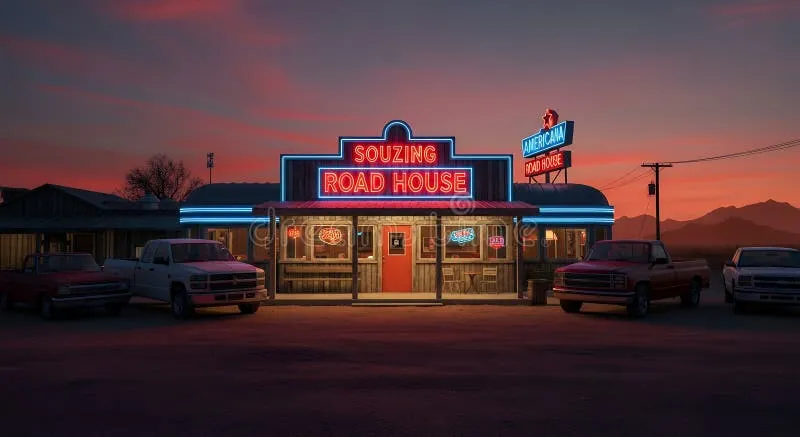
Photo: old roadhouse tavern rural American highway dusk exterior, via thumbs.dreamstime.com
One Foot Outside the Law: The Strange Comfort of America's Border Taverns
There is a building in southern Indiana that sits close enough to the Kentucky state line that, depending on which account you believe, its bar was in one state and its back room was in another. The precise location of the boundary was disputed for decades, which was, almost certainly, entirely intentional.
The people who built that place understood something about human psychology that legal theorists and social scientists have spent careers trying to articulate: there are things people will say, admit, agree to, and confess only when they are standing somewhere that belongs fully to neither side of a line. The threshold is not a neutral space. It is a productive one.
The Jurisdiction Gap as Social Technology
America's border taverns — the roadhouses positioned just past county lines, state lines, and the outer edges of dry-town ordinances — are usually discussed as a footnote to Prohibition history or as a curiosity of pre-interstate road culture. That framing misses almost everything interesting about them.
They were, in functional terms, a technology. A social technology developed to solve a problem that every organized society eventually produces: the problem of what to do when the things people need to discuss, negotiate, or confess cannot safely be done inside the jurisdiction where they live.
This is not a uniquely American problem. It is not even a modern one.
The ancient Greeks had specific locations — often at crossroads, often outside city walls — where disputes between parties from different city-states could be negotiated. Medieval European fairs operated under special legal dispensations that suspended normal local rules for their duration, creating temporary threshold spaces where merchants from different jurisdictions could conduct business without either side having a clear legal advantage over the other. The Roman concept of the limen — the threshold, the boundary — was embedded so deeply in religious and legal thought that crossing a boundary was understood as a qualitatively different act from simply moving through space.
The county-line roadhouse is the American folk version of a very old architecture.
What Actually Happened in These Places
Drinking is the obvious answer, and it's not wrong. But the drinking was often incidental to the function.
Debt settlements happened at border taverns because a neutral location meant neither party had a home-court advantage with the local constable. Business deals got witnessed there because the witnesses couldn't easily be subpoenaed by courts in either adjacent jurisdiction. Labor organizers in the early 20th century used county-line roadhouses for meetings that would have been broken up — legally or otherwise — if held inside the county where their members worked.
And confessions happened. Not religious confessions, though the parallel is not entirely metaphorical. The kind of confession where a person says something true that they cannot say inside the geography of their normal life. Affairs were admitted to. Alliances were revealed. The roadhouse at the county line was where the version of events that couldn't be spoken in town got spoken.
The psychology driving this is straightforward and ancient: humans modulate their behavior based on who has jurisdiction over them. Move outside that jurisdiction, even by fifty feet, and something loosens. The internal censor relaxes. The calculation about consequences shifts.
Surviving Examples and Where to Find Them
The honest answer is that the most interesting surviving border taverns are not well-marked. They are not on heritage tourism maps. Some of them are still operating as bars, which means their history is present in the building's bones rather than in any interpretive signage.
The stretch of road along the old Kentucky-Tennessee border south of Nashville has several candidates — establishments that predated the interstate and were positioned with a specificity that is hard to attribute to coincidence. The geography of dry counties across the South created a roadhouse economy so consistent that you can still trace its outlines by looking at where the oldest surviving rural bars cluster relative to county lines.
In the Midwest, the Missouri-Kansas border has a long history of exactly this dynamic. The border between wet and dry jurisdictions shifted multiple times over the 19th and 20th centuries, and the bars that survived those shifts tended to be the ones positioned to benefit from whatever the current legal geography happened to be — which is to say, the ones built right at the line.
Ozark County, Missouri, and its neighbors offer some of the most intact rural roadhouse architecture in the country, though what you're looking for requires some patience and a willingness to stop at places that don't advertise their history.
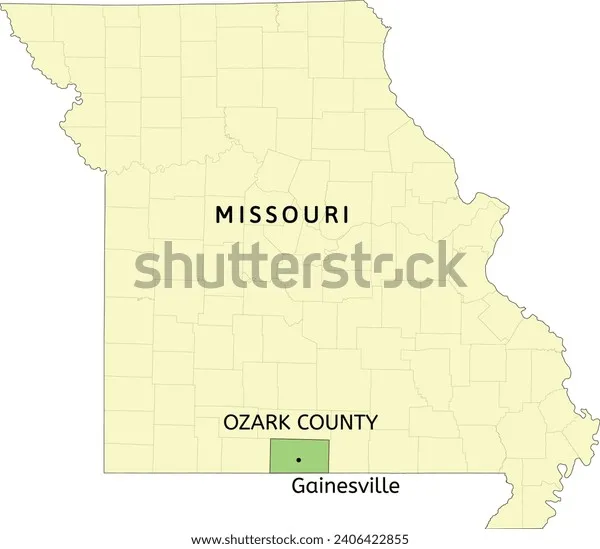 Photo: Ozark County, Missouri, via www.shutterstock.com
The Threshold Doesn't Disappear
The specific legal conditions that made the county-line roadhouse necessary have mostly dissolved. Dry counties still exist — more than you'd think — but the patchwork of alcohol regulations that once made the county line a meaningful economic and social boundary has simplified considerably.
But the human need that produced those buildings has not simplified at all.
Look at where consequential conversations still happen in American life. They happen in cars, which are mobile thresholds — spaces that belong to neither the origin nor the destination. They happen in airport lounges and hotel bars, which are spaces explicitly designed to be outside normal social geography. They happen, with remarkable consistency, in places that are in-between.
The therapist's office is a formalized version of the county-line roadhouse. So is the confession booth. So is the lawyer's conference room with its explicit confidentiality protections. Every one of these is a built response to the same human requirement: a space where the rules of the outside world are temporarily suspended, where what is said here stays here, where the jurisdiction of normal consequences does not reach.
What the Building Knows
The most interesting thing about passing through one of these surviving border establishments — really passing through, with some awareness of what the building has been — is the way the physical space confirms the psychology.
These places were built to feel like neither here nor there. Low ceilings. Dim lighting. Entrances that don't announce themselves. The architecture of a place designed to be present without being conspicuous, to exist without being fully acknowledged.
That design was not accidental. It was the physical expression of a social function: a space that needed to be accessible but not visible, present but not official, real but not on the record.
Humans have been building these spaces, in one form or another, for as long as they have been building anything. The county line just gave the American version a specific address.