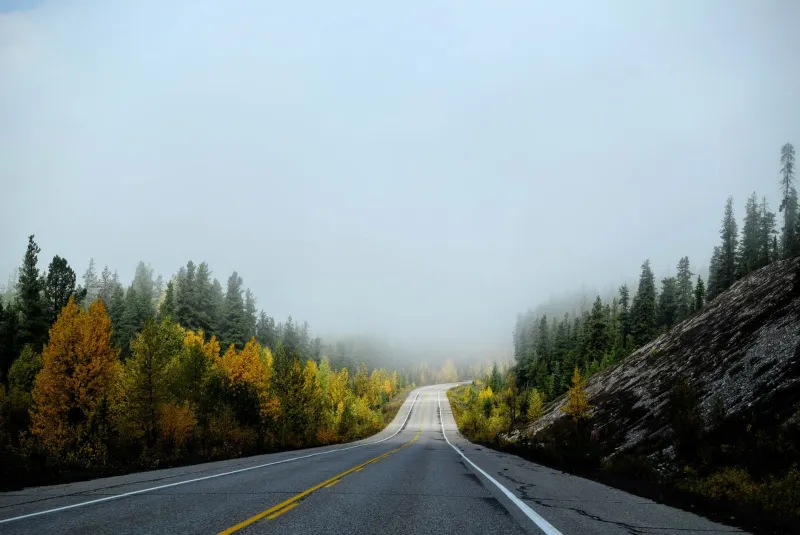
Somewhere in America right now, a family is pulling off an interstate onto a two-lane road marked with a small brown sign. The sign says something like Historic Byway or Scenic Corridor or Heritage Route. The GPS is recalculating. The drive will take forty minutes longer than it needed to. Everyone in the car will agree, later, that it was the best part of the trip.
This is not spontaneous. None of it is.
The brown sign was lobbied for. The route was designated by a committee. The overlooks were graded and the pullouts were paved and the interpretive markers were written by someone with a budget and a mandate. The feeling of stumbling onto something unhurried and authentic was, to a meaningful degree, manufactured — and the manufacturing goes back much further than the highway era.
Efficiency Was Never the Whole Pitch
For most of human history, roads existed to move things from one place to another as reliably as possible. Roman roads were engineering achievements, but they were logistics infrastructure first. The postal roads of colonial America were about getting letters to the right place, not about the experience of riding them. Speed, directness, and predictability were the virtues.
And then, gradually, they weren't.
By the early nineteenth century, something interesting was happening in how Americans talked about travel. The journey was starting to compete with the destination as the thing worth describing. Washington Irving was writing about the Hudson Valley in ways that made the landscape itself the attraction. The Hudson River School of painters was turning American scenery into a commodity — something to be sought out, experienced, and reported back on. Tourism, as a distinct category of travel with its own economics and its own vocabulary, was assembling itself.
The key insight driving all of it was simple: some people, given the choice between the fast route and the interesting one, will choose interesting every time. And those people will pay for the privilege.
The Manufactured Pastoral
When the automobile arrived and the question of how to route American highways became a federal concern, the tension between efficiency and experience was already well established. The engineers wanted straight lines. The tourism boosters wanted something else.
The Blue Ridge Parkway, completed in stages between 1935 and 1987, is the purest expression of what the tourism-first argument eventually produced. The road was explicitly designed to be slow. The speed limit tops out at 45 mph. There are no commercial vehicles, no billboards, no gas stations within the corridor itself. The entire 469-mile length was engineered to feel like an escape from the engineered world — which is a paradox that the Parkway's designers were apparently comfortable with.
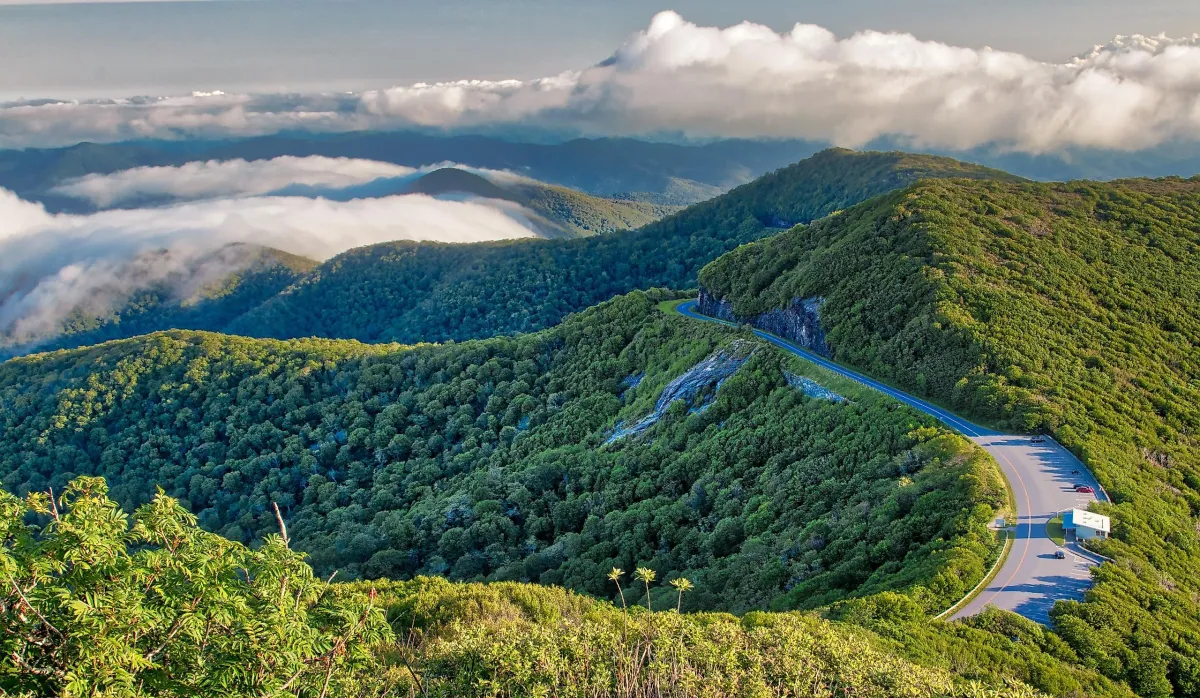 Photo: Blue Ridge Parkway, via www.worldatlas.com
It worked spectacularly. The Blue Ridge Parkway consistently ranks as one of the most visited units in the entire National Park System, pulling in fifteen to twenty million visitors in good years. People drive it specifically because it refuses to be efficient. The inconvenience is the product.
This is not unique to the Parkway. Route 66 was a working transportation corridor before it became a nostalgia circuit, but the moment through-traffic shifted to I-40, the towns along the old route pivoted almost immediately to selling the experience of the road itself. The roadside diners and motor courts that had served actual travelers became attractions for people who wanted to feel what actual travel used to be like. The thing being sold was authenticity, and the price point was whatever the market would bear.
Why the Slower Road Wins
Human psychology on this point is remarkably consistent across time and culture. Studies on what's sometimes called the "journey mindset" find that people systematically undervalue efficiency when they're in a context they've mentally coded as leisure. The commute should be fast. The vacation should be rich.
But it goes deeper than that. There's something about choosing difficulty — the longer route, the harder climb, the road that requires actual attention — that produces a stronger memory trace than the frictionless alternative. Psychologists call this the effort heuristic in some contexts and the IKEA effect in others, but the underlying mechanism is the same: we value things more when we've worked for them, and we remember experiences more vividly when they required something from us.
The medieval pilgrimage routes understood this intuitively, even without the research. The Camino de Santiago wasn't designed to be the fastest way to get to a cathedral in northwestern Spain. It was designed to be transformative, and the physical difficulty was the mechanism. You arrived changed because the road had demanded something from you. The destination was almost secondary.
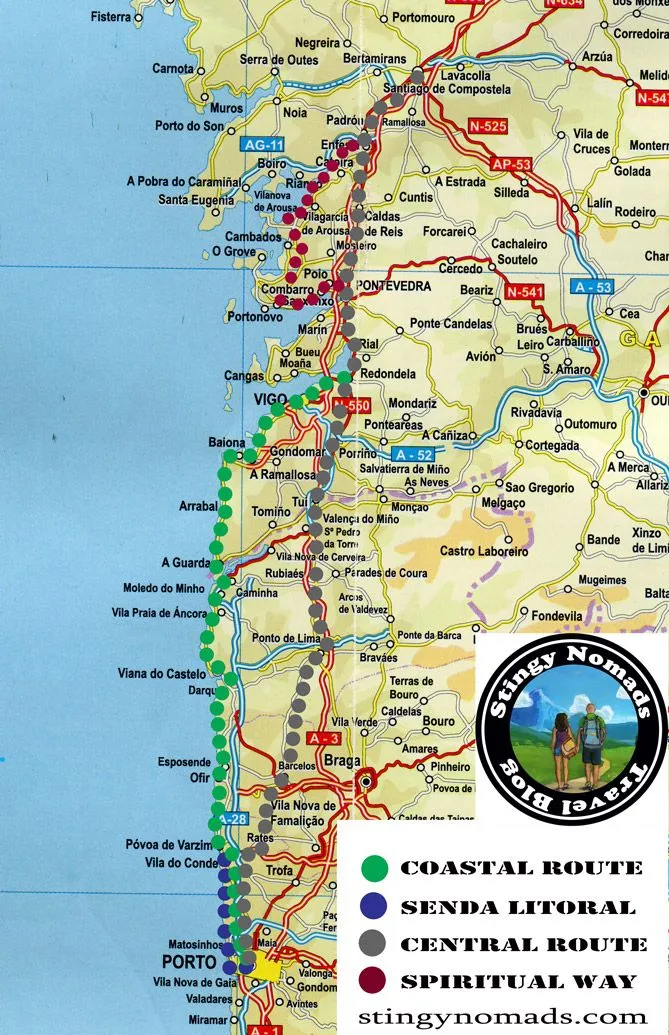 Photo: Camino de Santiago, via i.pinimg.com
American scenic byways are a secular, automobile-scaled version of the same idea. The Brown Sign signals: this will take longer and ask more of you, and that is exactly why you should take it.
Who's Selling the Slowness
The designation process for scenic and historic routes in the United States involves a web of federal agencies, state tourism offices, regional economic development boards, and local advocacy groups — all of whom have a stake in whether a particular stretch of road gets the brown sign treatment.
The America's Byways program, administered through the Federal Highway Administration, requires applicants to demonstrate that a route has qualities worth protecting and promoting: scenic, historic, cultural, natural, recreational, or archaeological. But the application process itself is a lobbying exercise. Communities that successfully navigate it gain a federally recognized brand, access to promotional infrastructure, and the kind of tourism traffic that follows official designation.
This doesn't make the roads less beautiful. The Natchez Trace Parkway is genuinely extraordinary. The Going-to-the-Sun Road in Glacier National Park is as close to sublime as American pavement gets. The manufactured quality of the experience doesn't cancel the experience.
But it's worth knowing, when you pull off onto that two-lane road with the brown sign, that someone decided you would pull off there. Someone calculated that your desire for the unhurried, the storied, and the scenic was worth investing in. Someone was right.
The Road Less Traveled Was Graded First
The deepest irony of American scenic tourism is that the feeling of escape it sells — from the interstate, from the commercial strip, from the relentless efficiency of modern infrastructure — is itself a product of the same planning apparatus it appears to reject.
You can't accidentally wander onto the Blue Ridge Parkway. You have to choose it. And the fact that choosing it feels like a small act of freedom, a minor rebellion against the GPS's preferred route, is part of what you're paying for.
That's not a criticism. It's just the honest description of a transaction that human beings have been willing to make, in various forms, for a very long time. We want the journey to mean something. We want the road to have a story. We want to arrive somewhere feeling like we earned it.
Somebody figured that out a long time ago, and they've been building roads to match ever since.